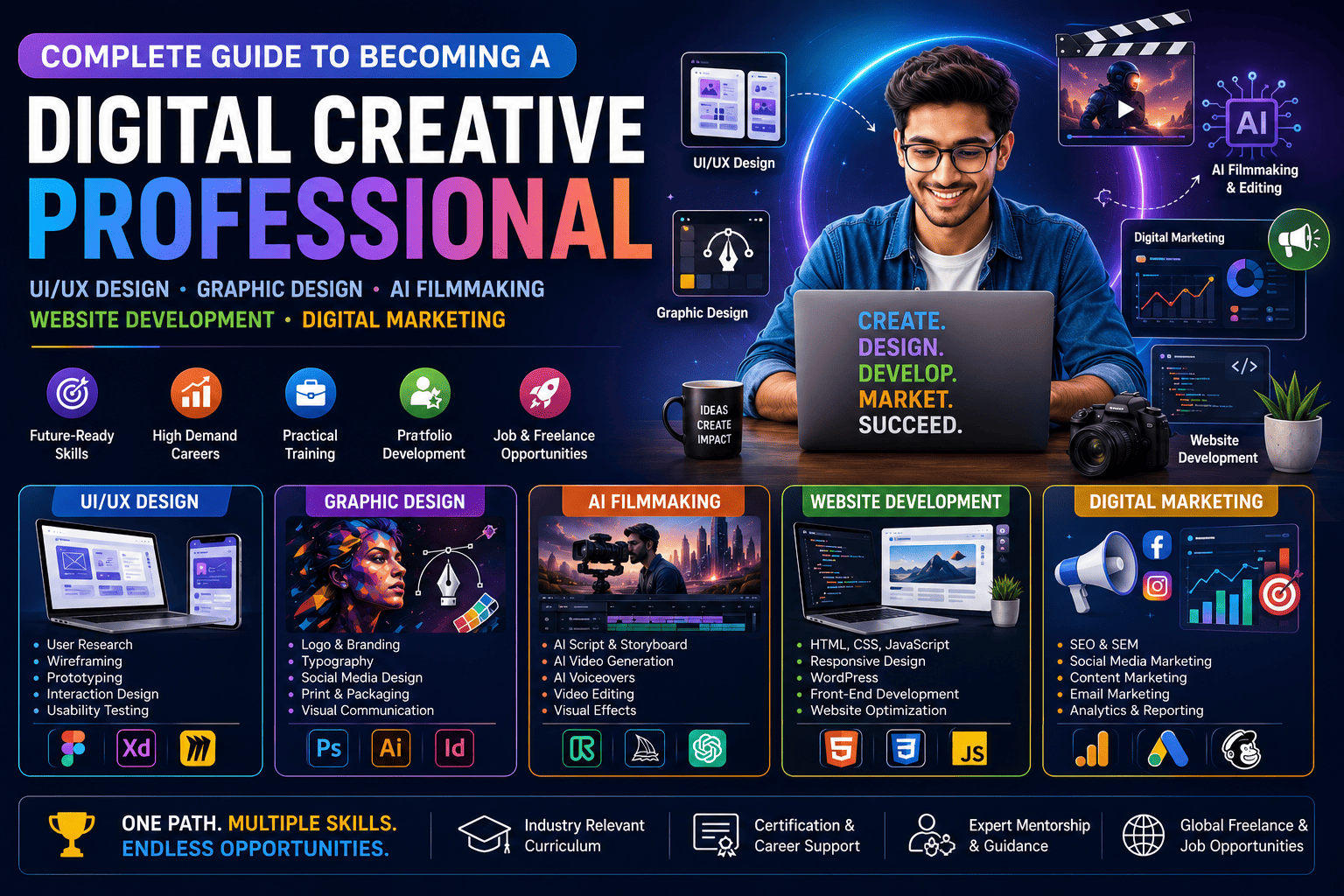
The digital economy is creating exciting opportunities for professionals who combine creativity, technology, marketing, and artificial intelligence. Businesses today are looking for individuals who can design intuitive user experiences, develop visually compelling brands, produce AI-powered multimedia content, build responsive websites, and promote products through digital marketing.
This comprehensive guide explains how to become a digital creative professional by learning UI/UX Design, Graphic Design, AI Filmmaking, Website Development, and Digital Marketing in a structured way. Whether you’re a student, graduate, freelancer, entrepreneur, or working professional, these future-ready skills can help you build a successful career in the modern digital landscape.
Who Is a Digital Creative Professional?
A digital creative professional is someone who combines design, technology, storytelling, and marketing to create impactful digital experiences. Rather than focusing on a single specialization, these professionals understand multiple stages of the creative process and can contribute across design, development, content creation, and promotion.
Typical responsibilities include:
- Designing intuitive user interfaces
- Creating visual brand identities
- Producing AI-assisted videos and multimedia
- Building responsive websites
- Planning and executing digital marketing campaigns
- Optimizing user engagement and conversions
This multidisciplinary approach makes professionals more adaptable and valuable in today’s competitive job market.
Why These Skills Matter in the AI Era
Artificial Intelligence is transforming creative workflows, but organizations still rely on human creativity, empathy, strategy, and problem-solving.
Professionals who combine technical expertise with AI literacy can:
- Deliver projects faster
- Improve productivity
- Experiment with creative ideas
- Personalize digital experiences
- Solve complex business challenges
- Stay relevant as technology evolves
Learning AI alongside traditional creative skills helps future-proof your career.
1. UI/UX Design – Building Exceptional User Experiences
UI (User Interface) and UX (User Experience) Design focus on creating digital products that are intuitive, accessible, and visually engaging.
Skills You’ll Learn
- User Research
- User Personas
- Wireframing
- Interactive Prototyping
- Information Architecture
- Design Systems
- Responsive Design
- Accessibility Standards
Popular Tools
- Figma
- Adobe XD
- Miro
- Maze
Career Opportunities
- UI Designer
- UX Designer
- Product Designer
- Interaction Designer
2. Graphic Design – Communicating Through Visual Creativity
Graphic design forms the foundation of branding and visual communication.
Core Topics
- Logo Design
- Brand Identity
- Typography
- Color Theory
- Layout Design
- Packaging Design
- Social Media Graphics
- Advertising Design
Industry Software
- Adobe Photoshop
- Adobe Illustrator
- Adobe InDesign
Career Options
- Graphic Designer
- Brand Designer
- Marketing Designer
- Visual Communication Specialist
3. AI Filmmaking – Transforming Digital Storytelling
AI-powered filmmaking enables creators to produce high-quality videos more efficiently by assisting with scripting, visuals, editing, and audio production.
What You’ll Learn
- AI Script Writing
- AI Storyboarding
- AI Video Generation
- AI Voiceovers
- AI Image Creation
- Prompt Engineering
- Video Editing
- Post-Production Workflows
Popular AI Platforms
- ChatGPT
- Runway
- Kling AI
- Pika
- Adobe Firefly
- Midjourney
- ElevenLabs
Career Opportunities
- AI Filmmaker
- Video Producer
- Multimedia Creator
- Creative Content Specialist
4. Website Development – Bringing Ideas to Life
Website development transforms designs into interactive digital experiences that are functional, responsive, and optimized for performance.
Skills Covered
- HTML5
- CSS3
- JavaScript
- Bootstrap
- Responsive Web Design
- WordPress
- Basic React Concepts
- Website Optimization
Career Roles
- Web Designer
- Front-End Developer
- WordPress Developer
- Website Consultant
5. Digital Marketing – Connecting Creativity with Business Growth
Digital marketing ensures creative work reaches the right audience and delivers measurable results.
Learning Modules
- Search Engine Optimization (SEO)
- Search Engine Marketing (SEM)
- Social Media Marketing
- Content Marketing
- Email Marketing
- Google Analytics
- Performance Marketing
- Conversion Rate Optimization
Career Opportunities
- Digital Marketing Executive
- SEO Specialist
- Performance Marketer
- Social Media Manager
- Content Strategist
How These Skills Work Together
A complete digital project typically involves:
- Understanding user needs through research.
- Designing intuitive interfaces.
- Developing a visual identity.
- Producing engaging AI-assisted multimedia.
- Building a responsive website.
- Launching digital marketing campaigns.
- Measuring user engagement and optimizing performance.
Professionals who understand each stage can contribute more effectively to multidisciplinary teams.
The Role of Generative AI in Creative Work
Generative AI is becoming an essential productivity tool across design, development, and marketing.
AI Applications
- Design Ideation
- Image Generation
- Code Assistance
- Video Editing
- Content Creation
- Campaign Planning
- Workflow Automation
- Personalization
AI complements human creativity by handling repetitive tasks while allowing professionals to focus on innovation and strategic thinking.
Who Should Learn These Skills?
This learning path is suitable for:
- Students
- Graduates
- Working Professionals
- Career Changers
- Freelancers
- Entrepreneurs
- Startup Founders
- Marketing Professionals
- Designers
- Content Creators
Essential Soft Skills for Success
Technical expertise is important, but employers also value:
- Communication
- Team Collaboration
- Creative Thinking
- Design Thinking
- Problem Solving
- Time Management
- Adaptability
- Critical Thinking
- Client Management
- Continuous Learning
Developing these skills improves your effectiveness in both employment and freelancing.
Career Opportunities
Professionals with multidisciplinary skills can pursue roles such as:
- UI/UX Designer
- Product Designer
- Graphic Designer
- Brand Designer
- AI Filmmaker
- Video Editor
- Multimedia Designer
- Web Designer
- Front-End Developer
- WordPress Developer
- Digital Marketing Executive
- SEO Specialist
- Creative Strategist
- Content Creator
- Freelancer
- Entrepreneur
Building a Strong Portfolio
A professional portfolio should include:
- UI/UX Case Studies
- Branding Projects
- Website Designs
- AI Video Productions
- Graphic Design Samples
- Marketing Campaigns
- Process Documentation
- Client Testimonials (where applicable)
Your portfolio demonstrates your skills more effectively than certifications alone and helps employers or clients evaluate your capabilities.
Future Trends Shaping Digital Creative Careers
Emerging trends include:
- AI-Assisted Design
- Hyper-Personalized User Experiences
- Interactive Storytelling
- Voice Interfaces
- Immersive Digital Experiences
- Marketing Automation
- No-Code and Low-Code Development
- AI-Powered Content Production
Staying informed about these trends helps professionals remain competitive in a rapidly changing industry.
Frequently Asked Questions (FAQs)
1. What does a digital creative professional do?
A digital creative professional combines design, development, multimedia production, AI tools, and digital marketing to create engaging digital experiences and business solutions.
2. Can beginners learn all these skills?
Yes. A structured learning roadmap that starts with design fundamentals and progresses through development, AI, and marketing can help beginners build confidence and practical expertise.
3. Is AI replacing creative professionals?
No. AI assists with repetitive and time-consuming tasks, but human creativity, empathy, storytelling, strategic thinking, and decision-making remain essential.
4. Which industries hire digital creative professionals?
Technology, advertising, media, entertainment, education, healthcare, finance, e-commerce, startups, manufacturing, and corporate organizations all require multidisciplinary digital talent.
5. Can I start freelancing after learning these skills?
Yes. With a strong portfolio and practical experience, you can offer UI/UX design, branding, AI-assisted video production, website development, and digital marketing services to clients around the world.
6. Why is learning multiple digital skills beneficial?
Learning complementary skills helps you understand the complete digital workflow, collaborate effectively, adapt to evolving technologies, and expand your career opportunities across multiple industries.
Conclusion
The future of digital careers belongs to professionals who combine creativity, technology, marketing, and artificial intelligence into one versatile skill set. By learning UI/UX Design, Graphic Design, AI Filmmaking, Website Development, and Digital Marketing, you gain the ability to create complete digital experiences that deliver value for businesses and users alike.
Whether your goal is to secure a high-paying job, build a successful freelance career, or launch your own creative agency, investing in multidisciplinary digital skills provides a strong foundation for long-term success. Continue learning, build real-world projects, embrace AI responsibly, and maintain a compelling portfolio to thrive in the rapidly evolving digital economy.