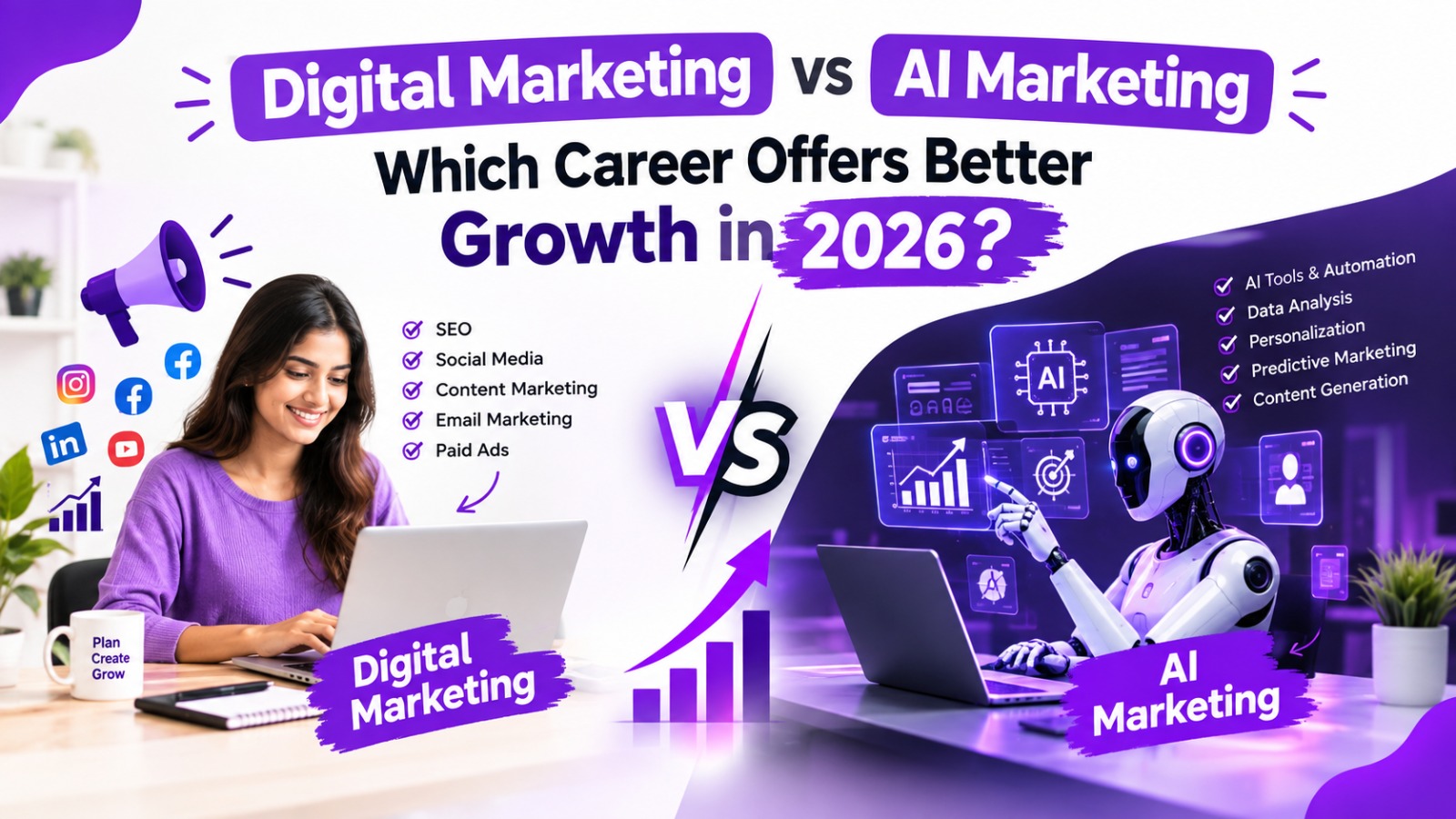
Digital marketing and AI marketing are closely connected, but they are not exactly the same career path. Digital marketing focuses on promoting products and services through channels such as search engines, social media, websites, email, content, and online advertising.
AI marketing adds artificial intelligence, automation, predictive analytics, personalization, and generative AI tools to marketing activities.
In 2026, professionals increasingly need a combination of marketing fundamentals and AI skills. Instead of treating Digital Marketing and AI Marketing as completely separate careers, beginners can build a strong foundation in digital marketing and then add AI-powered marketing skills.
What Is Digital Marketing?
Digital marketing is the promotion of products, services, brands, or businesses through digital channels.
It includes activities such as:
- Search Engine Optimization (SEO)
- Social Media Marketing
- Content Marketing
- Google Ads
- Meta Ads
- Email Marketing
- Affiliate Marketing
- Influencer Marketing
- Website Marketing
- Online Reputation Management
- Conversion Rate Optimization
- Web Analytics
A digital marketer studies audiences, creates campaigns, publishes content, manages advertisements, analyzes performance, and works to improve online visibility and conversions.
Example
Suppose an Ahmedabad-based training institute wants more students.
A digital marketer may:
- Create an SEO strategy.
- Optimize the institute’s website.
- Publish course blogs.
- Create Instagram and Facebook content.
- Run Google Ads.
- Run Meta Ads.
- Create email campaigns.
- Track website traffic.
- Analyze leads.
- Improve campaigns based on results.
What Is AI Marketing?
AI marketing refers to using artificial intelligence technologies to support, automate, analyze, or improve marketing activities.
AI can assist marketers with:
- Content generation
- Keyword research
- Customer segmentation
- Data analysis
- Personalization
- Predictive analytics
- Ad optimization
- Chatbots
- Marketing automation
- Customer journey analysis
- Social media content creation
- Email personalization
- Lead scoring
Generative AI can also help marketers produce initial drafts of articles, advertisements, social posts, email campaigns, scripts, and other marketing materials.
However, AI does not eliminate the need for marketing knowledge. A marketer still needs to understand the audience, business objective, brand positioning, customer journey, campaign strategy, and performance metrics.
Digital Marketing vs AI Marketing: Basic Difference
| Factor | Digital Marketing | AI Marketing |
|---|---|---|
| Main focus | Digital channels and marketing strategy | Marketing enhanced by AI |
| Core skills | SEO, social media, content, ads, email | AI tools + marketing + automation + analytics |
| AI dependency | Can work without advanced AI | Strongly incorporates AI |
| Content | Human-created and tool-assisted | AI-assisted and human-reviewed |
| Data analysis | Analytics platforms | AI-assisted analytics and prediction |
| Automation | Basic to advanced automation | Greater use of AI-driven automation |
| Beginner accessibility | Relatively accessible | Easier after learning marketing fundamentals |
| Career roles | SEO, SMM, PPC, content, email | AI marketing, automation, AI content, marketing analytics |
| Long-term value | Digital marketing foundation | Growing specialization built on marketing |
Digital Marketing Skills Required in 2026
A digital marketer should develop skills in several areas.
Core Skills
- SEO
- Social Media Marketing
- Content Marketing
- Google Ads
- Meta Ads
- Email Marketing
- Website Management
- Analytics
- Keyword Research
- Copywriting
Technical Skills
- Google Search Console
- Google Analytics
- Google Tag Manager
- WordPress
- Basic HTML and CSS
- Conversion tracking
- UTM parameters
- SEO tools
- Spreadsheet skills
Supporting Skills
- Canva
- Basic graphic design
- Video editing
- Communication
- Research
- Presentation
- Client communication
- Reporting
AI Marketing Skills Required in 2026
AI marketing requires marketing knowledge along with AI-related capabilities.
AI Tools
- Generative AI tools
- AI writing assistants
- AI image-generation tools
- AI video tools
- AI research tools
- AI analytics tools
- AI automation platforms
- AI chatbot tools
Marketing Skills
- SEO
- Content strategy
- Social media
- Advertising
- Email marketing
- Conversion optimization
- Customer research
Data and Automation Skills
- Data interpretation
- Customer segmentation
- Marketing automation
- Workflow creation
- Lead scoring
- Personalization
- Performance analysis
Why Is AI Becoming Important in Marketing?
Marketing involves large amounts of data and repetitive activities.
AI can help marketers process information faster and automate certain tasks.
For example, AI can assist with:
Research → Content → Campaign → Analysis → Optimization
Instead of manually performing every repetitive task, marketers can use AI tools to accelerate parts of the workflow.
However, the quality of the final marketing result still depends heavily on human judgment, strategy, fact-checking, creativity, and understanding of the target audience.
Digital Marketing Career Opportunities
A person with digital marketing skills can explore roles such as:
SEO Executive
Works on website visibility and search performance.
SEO Specialist
Handles more advanced SEO strategies, technical SEO, keyword research, and performance analysis.
Social Media Executive
Manages social media accounts and content.
Social Media Manager
Plans and manages broader social media strategies.
Content Writer
Creates website, blog, social media, and marketing content.
PPC or Google Ads Specialist
Manages paid search advertising campaigns.
Performance Marketing Specialist
Focuses on measurable advertising and conversion performance.
Email Marketing Specialist
Creates and manages email campaigns and automation.
Digital Marketing Executive
Works across multiple digital marketing activities.
Digital Marketing Manager
Coordinates marketing strategies, campaigns, teams, and reporting.
AI Marketing Career Opportunities
AI marketing is creating or reshaping roles such as:
- AI Marketing Specialist
- AI Marketing Strategist
- Marketing Automation Specialist
- AI Content Strategist
- AI SEO Specialist
- Marketing Analytics Specialist
- AI-Powered Performance Marketing Specialist
- CRM & Marketing Automation Specialist
- AI Chatbot or Conversational Marketing Specialist
- Growth Marketing Specialist
Some of these are emerging roles, while others are existing marketing roles increasingly incorporating AI.
Digital Marketing vs AI Marketing: Salary
Salary depends on several factors, including:
- Experience
- Location
- Company
- Job responsibilities
- Technical skills
- Industry
- Portfolio
- Certifications
- Communication skills
- Performance
A beginner should therefore avoid choosing a career based only on a salary number.
Instead, consider the skill progression:
Beginner → Executive → Specialist → Senior Specialist → Manager → Strategist/Consultant
Adding AI, analytics, automation, and technical skills can expand the range of responsibilities a marketer can handle.
Which Career Is Easier for Beginners?
For most beginners, Digital Marketing provides a straightforward starting foundation because it teaches fundamental concepts such as:
- Customer behavior
- Marketing funnels
- SEO
- Content
- Advertising
- Social media
- Analytics
Once these fundamentals are understood, AI tools can be introduced into the workflow.
A useful learning sequence is:
Digital Marketing Fundamentals → Practical Projects → Analytics → AI Tools → Automation → Advanced AI Marketing
Can Non-IT Students Learn Digital Marketing?
Yes.
Digital marketing is not restricted to computer science or IT graduates.
Students and professionals from backgrounds such as:
- Commerce
- Arts
- Science
- Management
- Design
- Humanities
- Business
- Other non-technical fields
can learn digital marketing.
Basic computer skills, communication, research ability, analytical thinking, and willingness to learn are useful starting points.
Is Coding Required for Digital Marketing?
Advanced programming is generally not required for most entry-level digital marketing roles.
However, understanding basic:
- HTML
- CSS
- Website structure
- Tracking
- URLs
- Analytics
- Technical SEO
can be helpful.
For AI marketing, technical skills can become more useful as the role moves toward automation, data, APIs, workflows, and advanced integrations.
Is AI Replacing Digital Marketers?
AI is changing marketing work, but it is more accurate to view AI as a technology that can automate or assist with certain tasks.
For example, AI can assist with:
- First drafts
- Research
- Data analysis
- Content variations
- Customer segmentation
- Reporting
- Automation
But marketers still need to decide:
- What should be communicated?
- Who is the target audience?
- What is the business objective?
- Which channel should be used?
- What message fits the brand?
- How should results be interpreted?
- What should be changed?
Therefore, learning how to work with AI is becoming an important marketing skill.
The Future of Digital Marketing in 2026
Digital marketing continues to evolve around several major areas.
SEO
Search behavior is becoming more complex, requiring marketers to focus on useful, trustworthy, well-structured content.
Social Media
Businesses continue to use social platforms for awareness, engagement, community building, and lead generation.
Video Marketing
Short-form and long-form video remain important content formats.
Performance Marketing
Businesses increasingly focus on measurable outcomes such as leads, conversions, and revenue.
Analytics
Data helps marketers understand campaign performance and customer behavior.
AI
AI is increasingly integrated into content, analytics, automation, personalization, and campaign workflows.
The Future of AI Marketing in 2026
AI marketing is developing around:
- Automated workflows
- Personalized customer experiences
- Predictive analytics
- AI-assisted content
- Automated customer support
- Intelligent chatbots
- Customer segmentation
- Marketing automation
- AI-assisted advertising
- Faster data analysis
The important point is that AI marketing is not completely separate from digital marketing.
AI is becoming a layer that can be added to many existing marketing functions.
Digital Marketing + AI: The Stronger Skill Combination
Instead of choosing only one side, beginners can develop both.
A modern marketing skill stack can look like this:
Digital Marketing
↓
SEO + Social Media + Content + Ads + Email
↓
Analytics
↓
AI Tools
↓
Automation
↓
Advanced AI Marketing
This approach provides both marketing fundamentals and modern technology skills.
Example Career Roadmap for Beginners
Marketing Fundamentals
Learn:
- Marketing basics
- Customer journey
- Marketing funnel
- Target audience
- Branding
- Content strategy
Digital Marketing
Learn:
- SEO
- Social media
- Content marketing
- Google Ads
- Meta Ads
- Email marketing
Website & Analytics
Learn:
- WordPress
- Google Search Console
- Google Analytics
- Google Tag Manager
- Basic HTML/CSS
- Reporting
AI Marketing
Learn:
- Generative AI
- AI content workflows
- AI research
- AI SEO
- AI analytics
- AI automation
Practical Projects
Create:
- A website
- SEO blogs
- Social media campaigns
- Google Ads campaign simulations
- Meta Ads campaign simulations
- Email campaigns
- AI-assisted content workflows
Portfolio
Document:
- What you created
- What problem you solved
- What tools you used
- What strategy you followed
- What results you achieved
Which Skills Should You Learn First?
For a complete beginner, follow this learning order:
Basic Computer Skills
↓
Marketing Fundamentals
↓
Content Writing
↓
SEO
↓
Social Media Marketing
↓
Canva & Basic Design
↓
Google Ads
↓
Meta Ads
↓
Email Marketing
↓
Google Analytics & Search Console
↓
WordPress
↓
AI Marketing Tools
↓
Automation
↓
Advanced Analytics
Digital Marketing vs AI Marketing: Skill Comparison
| Skill | Digital Marketing | AI Marketing |
|---|---|---|
| Marketing fundamentals | Essential | Essential |
| SEO | Essential | Essential |
| Social media | Essential | Important |
| Content | Essential | AI-assisted |
| Paid advertising | Important | Important |
| Analytics | Important | Very important |
| AI tools | Helpful | Core skill |
| Automation | Helpful | Core skill |
| Data analysis | Important | Very important |
| Creativity | Important | Important |
| Strategy | Essential | Essential |
| Customer understanding | Essential | Essential |
What Should Students Learn After 12th?
Students interested in marketing can start with basic digital marketing concepts.
A possible path is:
12th → Digital Marketing Fundamentals → Practical Projects → Internship → AI Marketing → Specialization
Possible specializations include:
- SEO
- Social Media
- Performance Marketing
- Content Marketing
- Email Marketing
- Marketing Analytics
- AI Marketing
- Marketing Automation
The right choice depends on individual interests, strengths, education, and career goals.
What Should Working Professionals Learn?
Working professionals can focus on skills that complement their existing experience.
For example:
Existing industry knowledge + Digital Marketing + AI
can be useful for marketing roles within that industry.
A finance professional could learn:
Finance + Marketing + AI
A designer could develop:
Design + Content + Digital Marketing + AI
A sales professional could develop:
Sales + CRM + Marketing Automation + AI
This approach can create a specialized skill combination instead of starting from zero in an unrelated field.
Common Mistakes Beginners Should Avoid
Learning Only AI Tools
Knowing how to use an AI tool does not automatically make someone a marketer.
Ignoring Marketing Fundamentals
AI cannot replace understanding customers, positioning, funnels, and strategy.
Learning Too Many Tools Simultaneously
Start with a small number of tools and learn how to apply them.
Only Watching Tutorials
Practical projects are necessary.
Not Building a Portfolio
A portfolio can demonstrate what you can actually do.
Ignoring Analytics
Marketing decisions increasingly depend on data and measurable outcomes.
Copying AI-Generated Content Without Review
AI-generated material should be reviewed for accuracy, originality, relevance, tone, and usefulness.
How to Build a Digital Marketing + AI Portfolio
A beginner can create a practice project for a fictional or personal business.
For example, create a marketing project for a training institute.
Website
Create a basic website.
SEO
Create:
- Keyword list
- SEO titles
- Meta descriptions
- Blog articles
- Internal links
Social Media
Create:
- Instagram posts
- Facebook posts
- LinkedIn posts
- Short videos
Paid Advertising
Create sample:
- Google Ads campaign
- Meta Ads campaign
AI
Use AI to assist with:
- Content ideas
- Keyword clustering
- Content outlines
- Ad variations
- Customer personas
- Reporting
Analytics
Prepare:
- Traffic report
- Engagement report
- Conversion report
This can become a practical portfolio project.
What Employers May Look For in 2026
Employers may look beyond certificates and consider whether candidates can actually perform marketing tasks.
Useful evidence includes:
- Portfolio
- Practical projects
- SEO knowledge
- Advertising knowledge
- Analytics
- Communication
- Content skills
- AI-tool proficiency
- Problem-solving
- Campaign understanding
- Reporting ability
A certificate can demonstrate learning, but practical application helps demonstrate capability.
How to Choose Between Digital Marketing and AI Marketing
Ask yourself:
Digital Marketing First
This can be a suitable starting path if:
- You are completely new to marketing.
- You want to understand marketing fundamentals.
- You want to learn SEO and social media.
- You are interested in advertising.
- You want to build websites and content.
- You want to work with businesses and clients.
Add AI Marketing
AI marketing skills can be added if:
- You want to automate repetitive tasks.
- You enjoy technology.
- You like data and analytics.
- You want to use generative AI.
- You are interested in automation.
- You want to improve marketing workflows.
For many beginners, these do not have to be mutually exclusive.
Digital Marketing + AI Career Path
A modern career path can look like:
Digital Marketing Executive
↓
SEO / Social Media / Performance Marketing Specialist
↓
Digital Marketing Specialist
↓
AI Marketing & Automation Specialist
↓
Marketing Strategist / Growth Marketer
↓
Marketing Manager / Consultant
The exact progression varies by company and individual skills.
Benefits of Learning Digital Marketing + AI
More Tools
You can use both traditional marketing platforms and AI tools.
Better Productivity
AI can assist with repetitive tasks.
Data-Driven Marketing
Analytics and AI can help process large amounts of information.
Better Automation
Marketing workflows can be automated where appropriate.
Wider Career Possibilities
You can explore traditional digital marketing as well as AI-focused marketing roles.
Frequently Asked Questions
What is the difference between Digital Marketing and AI Marketing?
Digital Marketing focuses on marketing through digital channels, while AI Marketing uses artificial intelligence to enhance areas such as content, analytics, personalization, automation, and customer engagement.
Is AI Marketing part of Digital Marketing?
AI Marketing can be considered an application of AI within marketing. Many AI marketing activities are performed through existing digital marketing channels.
Which should beginners learn first: Digital Marketing or AI Marketing?
Beginners can start with digital marketing fundamentals and then add AI marketing skills.
Can a non-IT student learn AI Marketing?
Yes. A non-IT student can learn AI marketing. Marketing fundamentals should be learned first, followed by AI tools, analytics, and automation.
Is coding necessary for AI Marketing?
Advanced coding is not necessary for many AI marketing roles. However, basic technical knowledge and understanding of automation, data, APIs, or integrations can become useful in more technical positions.
What skills are important for AI Marketing?
Important skills include digital marketing, SEO, content, analytics, AI tools, automation, customer research, personalization, and performance measurement.
Can I learn Digital Marketing and AI together?
Yes. A practical approach is to learn digital marketing fundamentals first and progressively integrate AI tools into SEO, content, advertising, analytics, and automation.
What is the future of Digital Marketing in 2026?
Digital marketing continues to evolve through SEO, social media, video, paid advertising, analytics, automation, personalization, and AI-assisted workflows.
What should I learn first if I have no experience?
Start with marketing fundamentals, then learn SEO, content, social media, paid advertising, analytics, website management, and finally AI and automation.
Conclusion
Digital Marketing and AI Marketing should not necessarily be viewed as competing career paths.
Digital Marketing provides the foundation for understanding customers, content, SEO, social media, advertising, email, websites, and analytics. AI Marketing builds on these fundamentals by introducing artificial intelligence, automation, personalization, data analysis, and AI-assisted workflows.
For someone starting from zero in 2026, a practical approach is:
Learn Digital Marketing → Build Practical Projects → Learn Analytics → Add AI Tools → Learn Automation → Build a Portfolio → Specialize.
Understanding marketing first and then learning how AI can improve marketing work can help professionals build a broader and more adaptable skill set as digital marketing technologies continue to evolve.