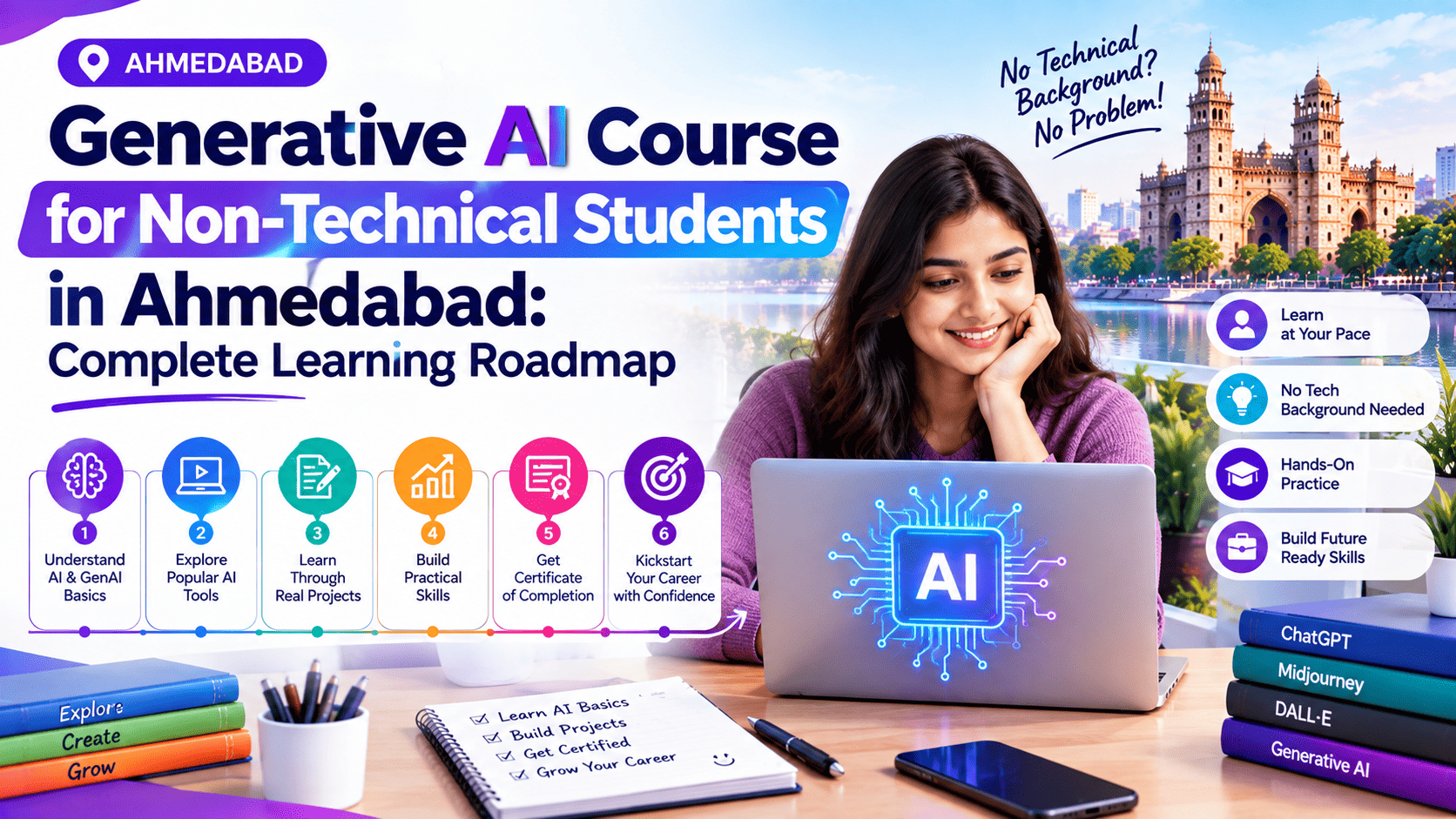
Generative AI is no longer limited to programmers, developers, or technology professionals. Students from commerce, arts, management, marketing, design, humanities, and other non-technical backgrounds can also learn how to use Generative AI for content creation, research, marketing, design, presentations, productivity, and business tasks.
For students in Ahmedabad, choosing a beginner-friendly Generative AI course for non-technical students can provide a structured way to understand AI without requiring advanced coding knowledge. The right course should start with AI fundamentals, gradually introduce prompting and AI tools, and then move toward practical projects and industry applications.
This complete learning roadmap explains what non-technical students can learn, which skills to develop first, how practical projects can build confidence, and how Generative AI can complement different career paths.
Introduction
Artificial Intelligence is becoming part of everyday digital work. From creating content and presentations to researching topics and developing marketing ideas, AI can assist with a wide range of professional tasks.
However, many students hesitate to learn AI because they believe it requires programming or advanced technical knowledge.
For many Generative AI applications, this is not necessarily the case.
A Generative AI course in Ahmedabad for non-technical students can introduce learners to AI through practical, easy-to-understand applications. Instead of beginning with complex programming, students can start by understanding how AI works at a basic level and then learn how to communicate effectively with AI systems.
The key is following a structured learning roadmap.
Can Non-Technical Students Learn Generative AI?
Yes. Non-technical students can learn many practical applications of Generative AI without having an advanced programming background.
For example, students can learn to use AI for:
- Content creation
- Research assistance
- Presentation creation
- Social media planning
- Digital marketing
- Graphic design assistance
- Video content planning
- Business communication
- Productivity
- Idea generation
- Document summarisation
However, learners interested in developing AI models, machine learning systems, or software applications may eventually need programming, mathematics, and additional technical knowledge.
Therefore, the learning path should match the student’s career objective.
Why Should Non-Technical Students Learn Generative AI?
Generative AI can complement existing academic and professional skills.
A commerce student can explore AI for accounting-related documentation and business communication.
A management student can use AI for research, presentations, marketing ideas, and business analysis.
A design student can explore AI-assisted creative workflows.
A digital marketing student can use AI for content planning, SEO, social media, and campaign ideation.
This makes Generative AI a supporting skill that can be combined with an existing field of study.
Complete Generative AI Learning Roadmap for Non-Technical Students
A structured roadmap can be divided into several stages.
Stage 1: Understand AI Fundamentals
The first step is to understand the basic concepts.
Students should learn:
- What is Artificial Intelligence?
- What is Machine Learning?
- What is Generative AI?
- What are Large Language Models?
- What is an AI model?
- How does AI generate content?
- What are the benefits and limitations of AI?
- What is responsible AI usage?
The objective at this stage is understanding, not programming.
Stage 2: Learn How to Communicate with AI
After understanding the basics, students can learn how to give effective instructions to AI systems.
This is commonly known as prompt engineering.
A good prompt can include:
Role + Context + Task + Requirements + Output Format
For example:
Act as a digital marketing assistant. Create a one-week social media content plan for a beginner-friendly computer training institute in Ahmedabad. Include post ideas, captions, target audience, and suggested formats.
Students can learn how changing the instructions can influence the quality and usefulness of the output.
Stage 3: Learn Basic Prompting Techniques
Beginners can gradually move from simple prompts to structured prompts.
Important concepts include:
- Clear instructions
- Context setting
- Role prompting
- Providing examples
- Specifying output formats
- Adding constraints
- Asking follow-up questions
- Refining AI responses
- Creating reusable prompts
The goal is to develop problem-solving skills with AI, rather than memorising hundreds of prompts.
Stage 4: AI-Assisted Content Creation
Non-technical students can learn how AI supports content workflows.
Applications include:
- Blog ideas
- Social media captions
- Email drafts
- Product descriptions
- Video scripts
- Content calendars
- Headlines
- Summaries
- Creative concepts
Students should also learn to fact-check, edit, and personalise AI-generated content.
AI output should be treated as a starting point that requires human review.
Stage 5: Learn AI for Research and Productivity
AI can also help students manage everyday academic and professional tasks.
Possible applications include:
- Summarising long documents
- Creating study notes
- Brainstorming ideas
- Preparing presentation structures
- Creating checklists
- Organising information
- Drafting professional communication
- Comparing concepts
- Generating questions for revision
Students should verify important information rather than relying on AI responses without checking.
Stage 6: Explore AI for Digital Marketing
Students interested in marketing can build additional skills.
Generative AI can support:
SEO
- Topic ideas
- Content briefs
- Search-intent analysis
- FAQ ideas
- Meta-description drafts
Social Media
- Content calendars
- Caption ideas
- Post concepts
- Campaign brainstorming
- Audience-specific messaging
Advertising
- Ad-copy variations
- Campaign concepts
- Customer personas
- Creative ideas
AI can accelerate marketing tasks, but strategy and decision-making still require human input.
Stage 7: Explore AI for Graphic Design
Non-technical students interested in design can explore AI-assisted creative workflows.
They can learn concepts such as:
- Text-to-image generation
- Creative ideation
- Visual concepts
- Background editing
- Marketing creatives
- Presentation visuals
- Design variations
- Moodboards
Students should combine AI with basic design principles such as composition, typography, hierarchy, branding, and visual consistency.
Stage 8: Explore AI-Assisted Video Creation
AI is increasingly being incorporated into multimedia workflows.
Depending on the course, learners may explore:
- Video concept generation
- Script writing
- Storyboarding
- Visual planning
- Voice assistance
- Short-form content planning
- AI-assisted editing workflows
This can be particularly useful for students interested in social media, content creation, marketing, and media.
Stage 9: Learn AI for Business Applications
Students from commerce and management backgrounds can explore practical business applications.
Examples include:
- Business idea generation
- Customer communication
- Market research assistance
- Report drafting
- Presentation preparation
- Meeting summaries
- Business content
- Workflow improvement
- Productivity systems
This allows non-technical students to connect AI learning with business knowledge.
Stage 10: Build Practical Gen AI Projects
Projects are an important part of the learning process.
Instead of only watching demonstrations, students should complete practical assignments.
Example Project Roadmap
| Level | Practical Project |
|---|---|
| Beginner | AI-powered content creation task |
| Beginner | AI-assisted presentation |
| Intermediate | Social media content campaign |
| Intermediate | AI-assisted SEO content workflow |
| Intermediate | AI-generated creative campaign |
| Advanced | Complete AI marketing project |
| Advanced | AI productivity workflow |
Projects can help students demonstrate their skills when building portfolios or discussing their capabilities during interviews.
Stage 11: Create a Gen AI Portfolio
Learning becomes more valuable when students can demonstrate what they have created.
A beginner portfolio could include:
- AI-assisted blog project
- Social media campaign
- Marketing content project
- Presentation
- AI-generated creative concepts
- Video project
- Prompt library
- Business workflow example
The portfolio should clearly explain the problem, AI workflow, human contribution, and final result.
Stage 12: Apply Gen AI to Your Existing Career Interest
One of the most important steps is connecting AI with your existing field.
Commerce Students
Explore:
- Business documentation
- Financial communication
- Reports
- Research
- Productivity
Management Students
Explore:
- Marketing
- Business research
- Presentations
- Customer communication
- Strategy brainstorming
Arts and Humanities Students
Explore:
- Writing
- Research
- Content creation
- Presentation development
- Communication
Design Students
Explore:
- Creative ideation
- Image generation
- Design concepts
- Presentation design
- Visual workflows
Marketing Students
Explore:
- SEO
- Social media
- Content strategy
- Advertising
- Campaign planning
Skills Non-Technical Students Should Develop
A Gen AI course should not focus only on individual tools.
Students should develop transferable skills such as:
1. Prompting
Writing clear and useful AI instructions.
2. Critical Thinking
Checking whether an AI response is accurate and relevant.
3. Editing
Improving AI-generated content with human judgement.
4. Research
Using AI to support research while verifying important information.
5. Creativity
Combining human ideas with AI-assisted generation.
6. Communication
Giving AI clear instructions and converting outputs into professional deliverables.
7. Problem Solving
Identifying where AI can improve a real task or workflow.
Do Non-Technical Students Need Coding?
For many beginner-level Generative AI applications, coding is not mandatory.
Students can learn practical applications such as:
- Prompt engineering
- AI content creation
- AI-assisted research
- Marketing workflows
- AI image generation
- AI video workflows
- Productivity applications
However, students who want to move toward technical AI careers such as machine learning engineering or AI development may need to learn programming languages, mathematics, data structures, machine learning, and other technical subjects.
What Should You Look for in a Gen AI Course in Ahmedabad?
Before joining a course, check the following:
| Factor | What to Look For |
|---|---|
| Beginner Friendly | No unnecessary technical barriers |
| Syllabus | Fundamentals to practical applications |
| Prompt Engineering | Structured prompting practice |
| Practical Projects | Realistic assignments |
| AI Tools | Relevant and regularly updated tools |
| Industry Training | Professional use cases |
| Portfolio | Projects that can be demonstrated |
| Certification | Clear course-completion credentials |
| Trainer Support | Guidance during assignments |
| Course Format | Classroom, online, or hybrid options |
The best course for one learner may not be the same for another. Your career objective and preferred learning style should guide the decision.
Benefits of a Practical Gen AI Course
A practical learning approach can help non-technical students:
- Understand AI without feeling overwhelmed
- Develop confidence with AI tools
- Improve productivity
- Create professional projects
- Explore new career possibilities
- Strengthen existing skills
- Build an AI-focused portfolio
- Prepare for AI-enabled workplaces
The biggest benefit is learning how to apply AI to real problems, rather than simply knowing how AI works.
Career Opportunities After Learning Generative AI
Generative AI is generally most useful when combined with another professional skill.
Potential areas include:
- Digital Marketing
- Content Creation
- Social Media
- Creative Design
- Business Operations
- Marketing Support
- Content Strategy
- AI-Assisted Research
- Presentation and Communication
- Creative Production
For non-technical students, combining domain knowledge + Generative AI skills can create a stronger professional profile than learning AI tools in isolation.
Generative AI Learning Roadmap at a Glance
Step 1: Understand AI fundamentals
↓
Step 2: Learn Generative AI concepts
↓
Step 3: Learn prompt engineering
↓
Step 4: Practise AI content creation
↓
Step 5: Learn AI productivity and research
↓
Step 6: Explore marketing/design/video applications
↓
Step 7: Complete practical projects
↓
Step 8: Build a portfolio
↓
Step 9: Apply AI to your chosen career field
↓
Step 10: Continue learning as AI tools evolve
Frequently Asked Questions
1. Can non-technical students learn Generative AI?
Yes. Many practical Generative AI applications can be learned without advanced programming knowledge. Students can begin with AI fundamentals, prompting, content creation, productivity, and practical projects.
2. Is coding required for a Generative AI course?
Coding is not required for many beginner-oriented Generative AI applications. Technical AI development and machine learning careers, however, require additional programming and technical skills.
3. Which Generative AI course is suitable for beginners in Ahmedabad?
Beginners should look for a course with simple AI fundamentals, prompt engineering, practical assignments, industry use cases, trainer guidance, and portfolio projects.
4. What can non-technical students do with Generative AI?
They can use AI for content creation, research, presentations, digital marketing, design ideation, video planning, communication, and productivity.
5. Is Generative AI useful for commerce students?
Yes. Commerce students can explore AI applications for business communication, documentation, research, reports, presentations, and productivity.
6. Can arts students learn Generative AI?
Yes. Arts and humanities students can apply Generative AI to writing, research, content development, presentations, communication, and creative projects.
7. Can Generative AI help digital marketing students?
Yes. AI can assist with content planning, SEO workflows, social media, advertising ideas, customer personas, and campaign brainstorming.
8. Are practical projects important in a Gen AI course?
Yes. Practical projects allow students to apply AI concepts to realistic tasks and demonstrate their skills through a portfolio.
9. How long does it take to learn Generative AI?
The learning time depends on the course structure and the learner’s goals. Basic applications can be learned relatively quickly, while advanced workflows require continuous practice.
10. Can Generative AI skills help with career development?
Generative AI can complement skills in areas such as marketing, content, design, business, communication, and operations. Career outcomes depend on the learner’s overall skills, experience, portfolio, and employer requirements.
Conclusion
A Generative AI course for non-technical students in Ahmedabad can be a practical way to develop modern digital skills without beginning with complex programming. The most effective learning journey starts with AI fundamentals and gradually progresses toward prompt engineering, content creation, productivity, marketing, design, practical projects, and portfolio development.
Rather than trying to learn every AI tool at once, students should focus on understanding how to identify a problem, choose an appropriate AI workflow, create useful prompts, evaluate the output, and improve the final result.
For students from commerce, management, arts, design, marketing, and other non-technical backgrounds, combining Generative AI with existing academic or professional skills can create a practical and adaptable skill set for an increasingly AI-enabled workplace.