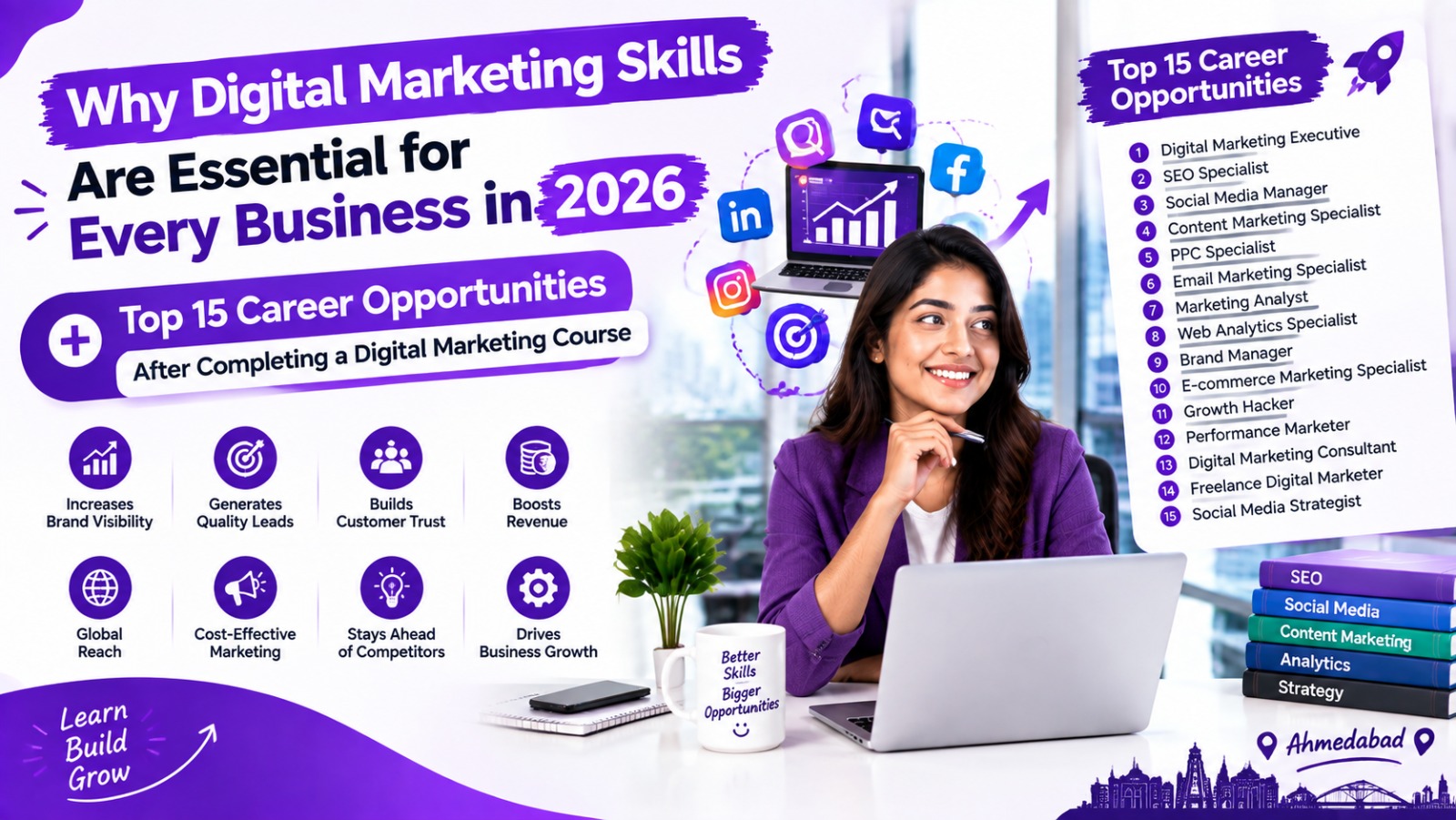
Digital channels have become an important part of how customers discover businesses, research products and services, compare options, communicate with brands, and make purchasing decisions.
In 2026, businesses need more than simply having a website or social media account. They need people who understand SEO, content marketing, social media, paid advertising, analytics, customer journeys, websites, conversion optimization, and AI-assisted marketing.
Digital marketing skills can help businesses reach relevant audiences, understand customer behaviour, measure campaign performance, and adapt their marketing activities based on data.
This guide explains why digital marketing skills matter in 2026, which skills businesses should focus on, how AI is changing marketing, and how companies can build a practical digital marketing strategy.
What Is Digital Marketing?
Digital marketing is the promotion of a business, product, service, or brand through digital channels.
These channels can include:
- Search engines
- Websites
- Social media
- Online advertising
- Video platforms
- Content platforms
- Mobile applications
- Online marketplaces
Digital marketing allows businesses to communicate with potential customers throughout different stages of the customer journey.
For example:
Customer searches on Google → discovers a website → reads content → compares services → sees social media content → submits an enquiry → receives an email → becomes a customer.
Different digital marketing channels can support different stages of this journey.
Why Digital Marketing Is Important for Businesses in 2026
Businesses operate in an increasingly digital environment.
Customers may use search engines, social media, online reviews, videos, websites, and other digital sources before contacting a business.
As a result, companies need to understand not only how to promote themselves online, but also how customers discover, evaluate, and interact with them.
Digital marketing skills can help businesses:
- Build online visibility
- Reach specific audiences
- Generate leads
- Increase website traffic
- Build brand awareness
- Communicate with customers
- Measure marketing performance
- Improve customer experiences
- Understand customer behaviour
- Support sales
1. Customers Search Online Before Making Decisions
One of the most important reasons digital marketing matters is that customers can research businesses before contacting them.
A potential customer might search for:
- Product information
- Service providers
- Prices
- Reviews
- Comparisons
- Locations
- Solutions to a problem
For example, someone looking for a training institute in Ahmedabad may search:
“Digital Marketing Course in Ahmedabad”
A business that has useful, well-structured online information has an opportunity to appear during this research process.
This is where SEO, content marketing, local SEO, and website optimization become important.
2. SEO Helps Businesses Become Discoverable
Search Engine Optimization (SEO) focuses on improving a website’s visibility in organic search results.
Important SEO skills include:
- Keyword research
- Search intent analysis
- On-page SEO
- Technical SEO
- Content optimization
- Internal linking
- Local SEO
- Website structure
- Search Console
- SEO analytics
For example, a local business in Ahmedabad may optimize its website for relevant searches related to its products or services.
SEO is not simply about adding keywords to a page. Modern SEO also requires useful content, good website structure, technical accessibility, and an understanding of what users are trying to accomplish.
3. Local Businesses Need Local Digital Marketing
Digital marketing is particularly important for businesses that serve specific geographic areas.
Examples include:
- Restaurants
- Clinics
- Training institutes
- Salons
- Real estate companies
- Retail stores
- Repair services
- Local professional services
Local digital marketing can involve:
- Google Business Profile
- Local SEO
- Location-specific website pages
- Customer reviews
- Local content
- Business directories
- Consistent business information
A business in Ahmedabad, for example, may want to appear when people search for relevant products or services in Ahmedabad and nearby areas.
4. Social Media Helps Businesses Build Relationships
Social media is more than a platform for publishing promotional posts.
Businesses can use social media to:
- Educate audiences
- Demonstrate products
- Answer questions
- Share company updates
- Build communities
- Collect feedback
- Showcase customer experiences
- Generate leads
- Support brand awareness
Important social media skills include:
- Content planning
- Copywriting
- Creative development
- Video content
- Community management
- Social analytics
- Paid social advertising
The most appropriate platform depends on the audience and business objectives.
5. Content Marketing Builds Long-Term Value
Content marketing involves creating useful information for a target audience.
Examples include:
- Blog articles
- Guides
- Videos
- Tutorials
- Case studies
- Infographics
- Social media content
- Email newsletters
- Frequently asked questions
Good content can help answer customer questions before a sales conversation takes place.
For example, an accounting firm could publish articles about:
- GST basics
- Business accounting
- Tax planning concepts
- Common accounting mistakes
The objective is not simply to publish large quantities of content. Content should be relevant, useful, accurate, and aligned with customer needs.
6. Paid Advertising Can Reach Target Audiences
Organic marketing can take time to build. Paid advertising can provide another way to reach potential customers.
Common advertising platforms include:
- Google Ads
- Meta Ads
- LinkedIn Ads
- Other digital advertising platforms
Digital advertising skills include:
- Audience targeting
- Keyword research
- Campaign structure
- Ad copy
- Creative testing
- Landing pages
- Budget management
- Conversion tracking
- Performance analysis
Businesses can use paid campaigns for objectives such as:
- Website traffic
- Lead generation
- Sales
- App promotion
- Brand awareness
7. Analytics Makes Marketing More Measurable
One of the major advantages of digital marketing is the ability to collect performance data.
Businesses can analyse metrics such as:
- Website traffic
- Search impressions
- Clicks
- Engagement
- Leads
- Conversion rates
- Advertising costs
- Cost per lead
- Customer acquisition costs
- Revenue
Tools such as Google Analytics and Google Search Console can provide useful information about website and search performance.
Analytics helps marketers move from:
“We think this campaign worked.”
to:
“Here is what the data shows about the campaign.”
However, metrics should always be interpreted in the context of business objectives.
8. AI Is Changing Digital Marketing in 2026
Artificial intelligence is increasingly being incorporated into marketing workflows.
AI can assist marketers with:
- Content ideation
- Research support
- Content outlines
- Drafting
- Ad-copy variations
- Keyword analysis
- Customer segmentation
- Data analysis
- Image generation
- Video concepts
- Personalization
- Marketing automation
For example, a marketer could use AI to generate several initial ideas for a social media campaign and then refine the selected concept using brand guidelines and human judgment.
The important skill is not simply knowing how to use an AI tool.
Marketers should also understand:
- Prompting
- Fact-checking
- Brand voice
- Data privacy
- Content quality
- Copyright considerations
- Human review
- Marketing strategy
AI can accelerate certain tasks, but marketing decisions still require context and judgment.
9. Search Is Becoming More Complex
Search behaviour is evolving beyond traditional blue-link search results.
Users may increasingly interact with:
- Search engines
- AI-generated answers
- Voice interfaces
- Maps
- Social platforms
- Video search
- Community platforms
This means businesses should think beyond traditional keyword rankings.
Content should clearly answer customer questions and provide useful information.
Important concepts include:
- SEO
- AEO
- AIO
- GEO
- Structured content
- Entity understanding
- Helpful content
- Clear FAQs
The exact visibility of a business across these surfaces depends on the platform, query, content quality, technical implementation, and other factors.
10. Digital Marketing Helps Small Businesses Compete
Digital marketing is not only for large companies.
Small businesses can use digital channels to reach specific audiences without needing the same marketing infrastructure as a large enterprise.
A small business can start with:
- A professional website
- Google Business Profile
- Local SEO
- Social media
- Useful content
- Customer reviews
- Email communication
- Basic analytics
For example, a local bakery can create location-focused content, maintain its online business profile, publish products on social media, and use customer reviews to strengthen its online presence.
11. Digital Marketing Supports Lead Generation
A business website should not only provide information. It can also help generate enquiries.
Lead-generation methods include:
- Contact forms
- WhatsApp buttons
- Phone calls
- Appointment forms
- Downloadable resources
- Newsletter sign-ups
- Landing pages
- Lead-generation advertising
The digital marketing team can then measure:
Visitors → Leads → Qualified Leads → Customers
This provides a clearer connection between marketing activities and business outcomes.
12. Conversion Optimization Is an Important Skill
Getting website traffic is only one part of digital marketing.
Businesses also need to consider what visitors do after arriving on a website.
Conversion optimization can involve:
- Clear calls to action
- Better landing pages
- Simple forms
- Better page structure
- Relevant content
- Trust signals
- Faster website performance
- Mobile-friendly design
For example:
1000 website visitors + 5 enquiries
and
1000 website visitors + 50 enquiries
represent very different outcomes.
Therefore, marketers need to consider both traffic and conversions.
13. Email Marketing Remains Useful
Email marketing allows businesses to communicate directly with people who have opted into their communications.
Businesses can use email for:
- Newsletters
- Product updates
- Offers
- Educational content
- Lead nurturing
- Customer communication
- Automated sequences
Important skills include:
- Audience segmentation
- Email copywriting
- Subject lines
- Automation
- Personalization
- Conversion tracking
- Performance analysis
14. Digital Marketing Requires Data Analysis Skills
Marketing professionals increasingly need to understand numbers.
Important concepts include:
- CTR
- Conversion rate
- Cost per click
- Cost per lead
- Cost per acquisition
- Return on ad spend
- Website traffic
- Engagement rate
For example:
Conversion Rate = Conversions ÷ Visitors × 100
Understanding metrics allows marketers to identify what is working, what needs improvement, and where marketing budgets are being spent.
15. Customer Understanding Is More Important Than Tools
Digital marketing involves many tools, but tools alone do not create a successful strategy.
A marketer should understand:
- Who is the customer?
- What problem do they have?
- What are they searching for?
- What information do they need?
- Why might they choose one business over another?
- What prevents them from converting?
- Which channel do they use?
This is why customer research and marketing strategy should come before simply opening advertising platforms or creating social media posts.
Essential Digital Marketing Skills for Businesses in 2026
Businesses can benefit from developing skills across several areas.
SEO Skills
- Keyword research
- Search intent
- On-page SEO
- Technical SEO
- Local SEO
- Content optimization
- Search Console
- SEO reporting
Content Skills
- Copywriting
- Blogging
- Video content
- Social media content
- Storytelling
- Content strategy
Social Media Skills
- Content planning
- Community management
- Platform strategy
- Social analytics
- Short-form video
Advertising Skills
- Google Ads
- Meta Ads
- Campaign management
- Audience targeting
- Creative testing
- Conversion tracking
Analytics Skills
- Google Analytics
- Search Console
- KPI tracking
- Conversion analysis
- Campaign reporting
- Basic data analysis
Website Skills
- WordPress
- Landing pages
- Basic HTML/CSS understanding
- Website structure
- Conversion optimization
- Technical SEO basics
AI Skills
- AI-assisted research
- Prompting
- Content ideation
- Data analysis support
- Workflow automation
- AI content review
Business Skills
- Customer research
- Marketing strategy
- Budget planning
- Communication
- Presentation
- Problem solving
Digital Marketing Skills for Different Types of Businesses
Not every business needs the exact same digital marketing strategy.
Local Business
Focus may include:
Local SEO + Google Business Profile + Reviews + Social Media + Website
E-Commerce Business
Focus may include:
SEO + Product Content + Paid Advertising + Social Media + Analytics + Email
B2B Business
Focus may include:
SEO + Content Marketing + LinkedIn + Email + Lead Generation + Analytics
Service Business
Focus may include:
Local SEO + Website + Content + Reviews + Lead Generation + Paid Advertising
Startup
Focus may include:
Content + SEO + Social Media + Paid Advertising + Analytics + Conversion Optimization
The strategy should be based on the audience, business model, customer journey, and objectives.
How Businesses Can Build a Digital Marketing Strategy in 2026
A practical process can look like this:
Step 1: Define the Business Goal
Decide whether the primary objective is:
- Brand awareness
- Website traffic
- Leads
- Sales
- App downloads
- Customer retention
Step 2: Identify the Target Audience
Understand:
- Demographics
- Needs
- Problems
- Search behaviour
- Preferred platforms
- Buying behaviour
Step 3: Analyse Competitors
Review:
- Websites
- SEO
- Content
- Social media
- Advertising
- Reviews
- Customer experience
Step 4: Select Appropriate Channels
Choose channels based on where the target audience is active and what the business needs to achieve.
Step 5: Create Useful Content
Develop content that answers real customer questions.
Step 6: Implement SEO
Optimize the website and content for relevant search queries.
Step 7: Use Paid Advertising Where Appropriate
Create targeted campaigns with measurable objectives.
Step 8: Track Performance
Monitor relevant KPIs.
Step 9: Analyse Results
Identify:
- What worked?
- What did not work?
- Which audience performed better?
- Which pages generated leads?
- Which campaigns produced conversions?
Step 10: Improve Continuously
Digital marketing should be treated as an ongoing process rather than a one-time activity.
Why Businesses Need Digital Marketing Professionals
Digital marketing involves multiple specialized activities.
One person may manage:
- SEO
- Social media
- Content
- Advertising
- Analytics
- Website optimization
- AI tools
In larger organizations, these responsibilities may be divided among specialists.
This is why businesses can benefit from employees or agencies that understand how different digital channels work together.
Digital Marketing Skills and Career Opportunities
The growing use of digital channels has created roles such as:
- Digital Marketing Executive
- SEO Executive
- SEO Specialist
- Social Media Executive
- Social Media Manager
- Content Marketing Executive
- PPC Executive
- Performance Marketing Executive
- Email Marketing Specialist
- Digital Marketing Analyst
- Marketing Automation Specialist
Students and working professionals can develop these skills through structured courses, practical projects, internships, and real-world experience.
How Students Can Build Digital Marketing Skills
Students can start by learning:
Digital Marketing Fundamentals
↓
SEO
↓
Content Marketing
↓
Social Media
↓
Google Ads & Meta Ads
↓
Analytics
↓
WordPress
↓
AI Tools
↓
Projects
↓
Portfolio
Students can then use their projects to demonstrate practical skills when applying for internships or entry-level roles.
How Working Professionals Can Learn Digital Marketing
Working professionals can focus on skills relevant to their current role or desired career transition.
For example:
Marketing Professional
Learn:
SEO + Ads + Analytics + Content
Business Owner
Learn:
SEO + Local Marketing + Social Media + Ads + Analytics
Sales Professional
Learn:
Lead Generation + CRM + Content + Email + Analytics
Non-Marketing Professional
Start with:
Digital Marketing Fundamentals + SEO + Social Media + Analytics
A focused learning path can be easier to manage than attempting to learn every digital marketing specialization simultaneously.
Common Digital Marketing Mistakes Businesses Should Avoid
Focusing Only on Followers
A large follower count does not automatically mean a business is achieving its business goals.
Ignoring SEO
Businesses can miss potential organic search traffic when their website and content are not optimized properly.
Running Ads Without Tracking
Advertising without conversion tracking makes it difficult to understand campaign performance.
Publishing Without a Strategy
Posting content randomly can make it difficult to build consistent communication with an audience.
Ignoring Mobile Users
A significant amount of online activity occurs on mobile devices, so websites and campaigns should provide a good mobile experience.
Using AI Without Human Review
AI-generated content can contain inaccuracies, generic language, or information that does not fit a brand’s needs.
Measuring the Wrong Metrics
Businesses should focus on metrics connected to their objectives instead of tracking every available number.
Future of Digital Marketing Skills
Digital marketing will continue to evolve as technology and customer behaviour change.
Important areas to watch include:
- Artificial intelligence
- Marketing automation
- Data analytics
- Search evolution
- Video marketing
- Personalization
- First-party data
- Conversion optimization
- Omnichannel marketing
- Customer experience
The specific platforms and tools may change, but fundamental skills such as understanding customers, creating useful content, analysing data, communicating clearly, and measuring business outcomes are likely to remain important.
Frequently Asked Questions
Why is digital marketing important for businesses in 2026?
Digital marketing helps businesses reach customers through channels such as search engines, websites, social media, email, online advertising, and digital content. It also provides ways to measure and analyse marketing activity.
What digital marketing skills are important in 2026?
Important skills include SEO, content marketing, social media marketing, paid advertising, analytics, conversion optimization, website management, email marketing, and AI-assisted marketing.
Is digital marketing useful for small businesses?
Yes. Small businesses can use digital marketing for local visibility, website traffic, customer communication, lead generation, and brand awareness.
How does AI help digital marketing?
AI can assist with content ideation, research, drafting, data analysis, personalization, creative development, and workflow automation. Human review remains important for accuracy, quality, and strategy.
Is SEO still important in 2026?
SEO remains relevant for helping websites become discoverable through search. However, businesses need to consider evolving search behaviour, content quality, technical accessibility, and multiple search and discovery platforms.
Do businesses need social media marketing?
Social media can be useful for businesses whose target audiences use social platforms. The appropriate platform and strategy depend on the business, audience, and objectives.
Why is analytics important in digital marketing?
Analytics helps businesses measure traffic, engagement, leads, conversions, advertising performance, and other KPIs. It can support data-informed marketing decisions.
Can digital marketing generate leads?
Yes. Websites, SEO, paid advertising, social media, email, landing pages, and other digital channels can support lead generation when they are aligned with the target audience and business objectives.
What is the most important digital marketing skill?
There is no single skill that is equally important for every business. A strong digital marketer combines customer understanding, strategy, channel knowledge, content, analytics, and communication.
Can students learn digital marketing?
Yes. Students can learn digital marketing through courses, projects, internships, and practical exercises and build portfolios to demonstrate their skills.
Conclusion
Digital marketing skills are increasingly important for businesses in 2026 because customers use digital channels throughout the buying journey.
Businesses need to understand how people search, discover, compare, interact, and convert online. This requires more than simply maintaining a website or posting on social media.
Key skills include SEO, content marketing, social media marketing, Google Ads, Meta Ads, analytics, website management, email marketing, conversion optimization, and AI-assisted workflows.
At the same time, businesses should avoid treating digital marketing as a collection of disconnected tools. The most effective approach is to connect customer needs → marketing strategy → appropriate channels → useful content → measurable actions → data analysis → continuous improvement.
For businesses and professionals in Ahmedabad and across India, developing practical digital marketing skills can help create a stronger foundation for competing in an increasingly digital marketplace in 2026.