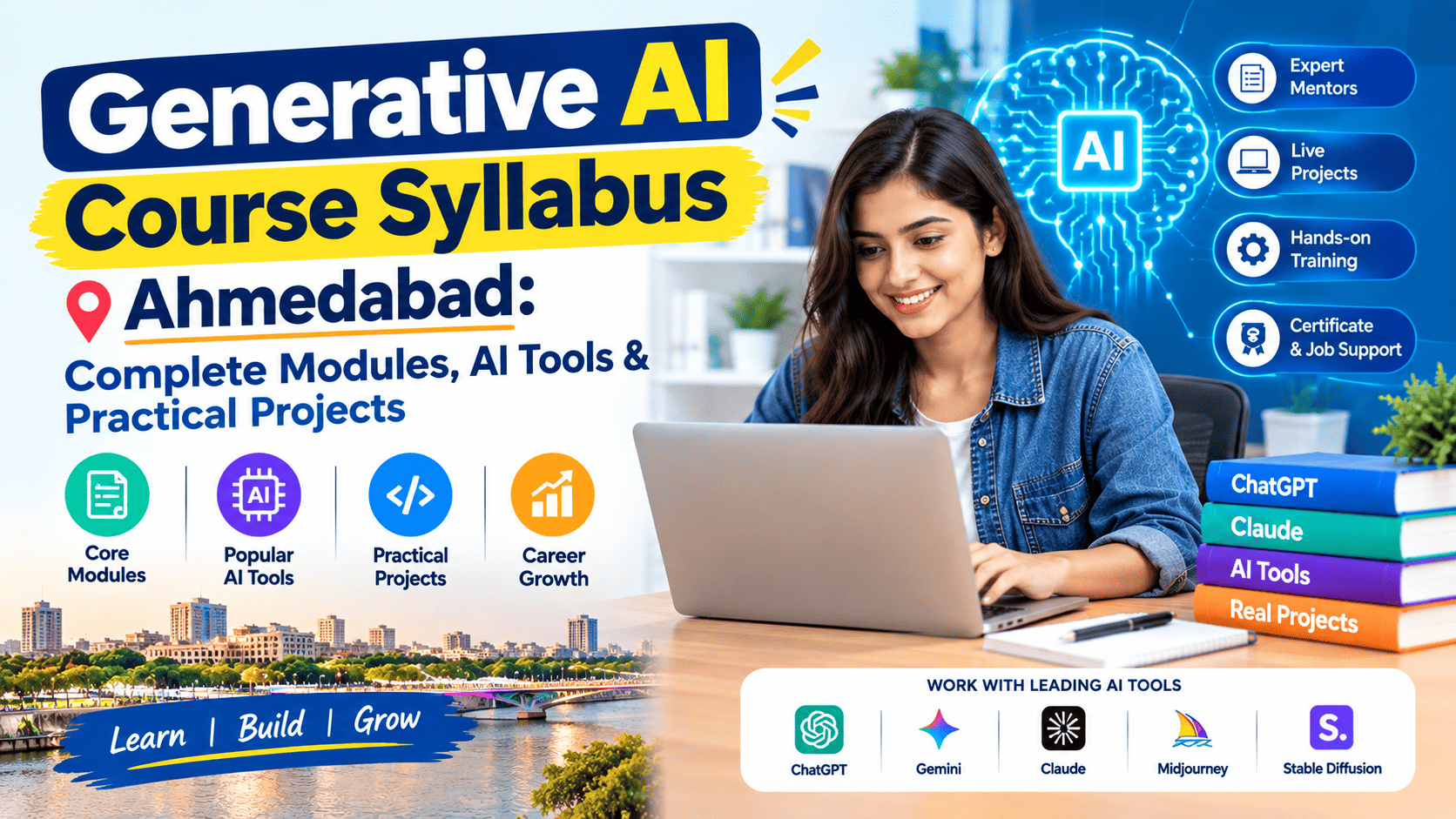
Generative AI is becoming an important skill for students, working professionals, digital marketers, designers, content creators, entrepreneurs, and other professionals. A structured Generative AI course can help learners understand AI concepts and apply them to real-world tasks such as content creation, research, marketing, design, presentations, productivity, and automation.
The Generative AI course syllabus in Ahmedabad can vary between institutes, but a comprehensive program generally covers AI fundamentals, Generative AI concepts, prompt engineering, text generation, image generation, video applications, AI-assisted content creation, marketing applications, productivity workflows, practical projects, and responsible AI usage.
This guide explains the major modules, types of AI tools learners may encounter, practical projects to look for, and how to evaluate a Generative AI course syllabus before joining.
What Is a Generative AI Course?
A Generative AI course teaches learners how to understand and practically use artificial intelligence systems that can generate or transform content.
Depending on the course level, learners may work with AI for:
- Text generation
- Content writing
- Research
- Summarization
- Prompt engineering
- Image creation
- Video creation
- Presentations
- Marketing
- Social media
- Design
- Business communication
- Productivity
- Workflow automation
A beginner-friendly course does not necessarily require programming knowledge. Many programs focus on using AI tools effectively for professional and creative applications.
Generative AI Course Syllabus in Ahmedabad: Complete Module Structure
A well-designed Generative AI course syllabus can be divided into beginner, intermediate, and advanced modules.
Module 1: Introduction to Artificial Intelligence
The first module should establish a basic understanding of AI.
Topics may include:
- What is Artificial Intelligence?
- History and evolution of AI
- Types of AI
- Machine Learning overview
- Deep Learning overview
- Generative AI introduction
- Traditional AI vs Generative AI
- Real-world applications of AI
- Advantages and limitations of AI
This foundation helps beginners understand where Generative AI fits within the larger AI ecosystem.
Module 2: Understanding Generative AI
After learning the basics, students can explore how Generative AI works at a practical level.
Topics may include:
- What is Generative AI?
- Generative models
- Large Language Models
- AI assistants
- Text-to-text generation
- Text-to-image generation
- Text-to-video concepts
- Multimodal AI
- Context and instructions
- AI output evaluation
The objective is not only to use AI tools but also to understand their capabilities and limitations.
Module 3: AI Tools and Generative AI Platforms
A practical course should introduce learners to different categories of AI tools.
Depending on the current curriculum, learners may explore tools for:
Text and AI Assistants
These tools can help with:
- Content generation
- Research
- Summarization
- Brainstorming
- Editing
- Planning
- Professional communication
Image Generation
AI image tools can be used for:
- Concept creation
- Marketing visuals
- Social media creatives
- Creative experimentation
- Design ideation
Video Generation
Learners may explore AI-assisted video workflows for:
- Scripts
- Storyboards
- Short videos
- Visual concepts
- Narration
- Social media content
Presentation Tools
Generative AI can assist with:
- Presentation outlines
- Slide content
- Visual concepts
- Business presentations
- Educational presentations
Because AI platforms change frequently, a good syllabus should be reviewed and updated regularly rather than depending on a fixed list of tools.
Module 4: Prompt Engineering
Prompt engineering is one of the most important practical skills in Generative AI.
Learners should understand how to communicate instructions clearly to an AI system.
Prompt Engineering Topics
- Basic prompts
- Clear instructions
- Context setting
- Role-based prompts
- Task-based prompts
- Few-shot prompting
- Structured prompts
- Output formatting
- Prompt refinement
- Prompt chaining concepts
- Reusable prompt templates
- Evaluating AI responses
Practical Prompt Exercises
Students can practice creating prompts for:
- Blog writing
- Social media posts
- Product descriptions
- Research
- Email writing
- Marketing campaigns
- Presentations
- Customer communication
The goal is to learn how to create useful, specific, and repeatable AI workflows.
Module 5: AI for Content Creation
Generative AI has many applications in content development.
Topics can include:
- Content ideation
- Blog outlines
- Article drafting
- Social media captions
- Product descriptions
- Email content
- Video scripts
- Content calendars
- Editing and rewriting
- Summarization
- Content optimization
Students should also learn the importance of fact-checking, human editing, originality, and maintaining the intended brand voice.
Module 6: Generative AI for SEO and Digital Marketing
For digital marketing students, this can be an important part of the syllabus.
Topics may include:
- AI-assisted keyword research
- Search-intent analysis
- Content planning
- Blog topic generation
- Meta title and description ideas
- Social media content
- Ad-copy ideas
- Email marketing
- Campaign brainstorming
- Content calendars
- Competitor research assistance
- Marketing workflow optimization
AI can support marketing tasks, but marketers should still apply their own strategy, audience understanding, and quality control.
Module 7: AI Image Generation and Creative Design
This module focuses on AI-assisted visual creation.
Topics may include:
- Text-to-image concepts
- Image prompting
- Visual style instructions
- Composition
- Creative direction
- Marketing visuals
- Social media graphics
- Concept development
- Image editing workflows
Practical Exercise
Students can create a complete visual campaign consisting of:
- Creative concept
- Image prompts
- Social media artwork
- Supporting captions
- Campaign description
This gives learners experience combining text and visual AI workflows.
Module 8: AI Video Generation
Video is another growing application of Generative AI.
Topics may include:
- AI video concepts
- Script generation
- Storyboarding
- Scene descriptions
- AI-assisted video production
- Voice and narration workflows
- Short-form video creation
- Social media video planning
- Video editing assistance
Practical Project
Learners can develop a short promotional video using an AI-assisted workflow from:
Idea → Script → Storyboard → Visuals → Voice/Narration → Editing → Final Video
Module 9: AI for Presentations
Generative AI can help simplify presentation development.
Students may learn how to use AI for:
- Presentation ideas
- Slide structures
- Content generation
- Speaker notes
- Visual concepts
- Presentation summaries
- Business presentations
- Educational presentations
Practical Project
Create a professional presentation on a selected business, marketing, educational, or technology topic using an AI-assisted workflow.
Module 10: AI for Productivity
Generative AI can also support everyday professional tasks.
Topics may include:
- Email drafting
- Meeting summaries
- Document summarization
- Brainstorming
- Task planning
- Research assistance
- Report preparation
- Spreadsheet-related assistance
- Professional communication
- Knowledge organization
This module can be especially useful for working professionals.
Module 11: Generative AI for Business Applications
Businesses can use AI in different departments and workflows.
Students can explore applications such as:
- Marketing
- Customer communication
- Sales support
- Business research
- Content development
- Internal documentation
- Process assistance
- Idea generation
- Business presentations
- Productivity workflows
The focus should be on identifying repetitive or information-heavy tasks where AI can provide assistance.
Module 12: AI Automation and Workflow Concepts
Advanced Generative AI courses may introduce automation concepts.
Topics can include:
- AI-assisted workflows
- Repetitive task automation
- Workflow planning
- AI integrations
- Structured outputs
- Trigger-based workflows
- No-code/low-code AI concepts
- Automated content workflows
The exact depth depends on the course level and whether the program is designed for technical or non-technical learners.
Module 13: AI for Different Professional Fields
A useful course can demonstrate how Generative AI applies to different careers.
For Digital Marketers
- Content planning
- Social media
- SEO assistance
- Ad-copy creation
- Campaign ideas
For Designers
- Creative ideation
- Visual concepts
- Image generation
- Design research
For Content Writers
- Topic research
- Outlines
- Drafting
- Editing
- Content repurposing
For Students
- Research assistance
- Presentations
- Project ideas
- Study support
- Summarization
For Business Professionals
- Emails
- Reports
- Presentations
- Research
- Productivity
Module 14: Responsible and Ethical Use of Generative AI
Learning how to use AI responsibly is an important part of professional training.
Topics may include:
- AI limitations
- Fact-checking
- Bias
- Privacy considerations
- Copyright awareness
- Data protection
- Human oversight
- Responsible content creation
- Avoiding misleading AI-generated information
Learners should understand that AI output should not automatically be treated as accurate or authoritative.
Module 15: Practical Generative AI Projects
Projects are an important part of a job-oriented Generative AI course.
A strong practical syllabus can include several small assignments followed by larger projects.
Project 1: AI Content Creation
Create a complete content package using AI:
- Topic research
- Content outline
- Article draft
- Editing
- Social media adaptation
Project 2: Social Media Campaign
Develop a campaign containing:
- Campaign concept
- Content calendar
- Captions
- Creative ideas
- AI-generated visual concepts
- Performance metrics framework
Project 3: AI Marketing Campaign
Create a marketing workflow covering:
Audience → Campaign Idea → Content → Creative → Distribution → Analysis
This project demonstrates how different AI applications can work together.
Project 4: AI Image Project
Develop a collection of AI-assisted visuals based on a defined creative brief.
Learners can practice:
- Prompt writing
- Visual direction
- Consistency
- Editing
- Creative selection
Project 5: AI Video Project
Create a short video using an AI-assisted workflow.
The project can include:
- Concept
- Script
- Storyboard
- Visual generation
- Voice/narration
- Editing
- Final output
Project 6: AI Business Productivity Workflow
Create a workflow for a fictional business that uses AI to assist with:
- Emails
- Research
- Reports
- Content
- Customer communication
- Internal documentation
Practical Training vs Theory-Based AI Courses
When comparing Generative AI courses in Ahmedabad, practical exposure should be an important consideration.
| Theory-Focused Course | Practical-Focused Course |
|---|---|
| AI concepts | AI concepts + application |
| Tool demonstrations | Hands-on tool practice |
| Limited assignments | Regular assignments |
| Basic explanations | Real-world workflows |
| Less project work | Portfolio-oriented projects |
| General knowledge | Professional application |
For career-oriented learners, a combination of concepts, guided practice, assignments, and projects can provide a more complete learning experience.
How to Choose a Generative AI Course in Ahmedabad
Before enrolling, evaluate the syllabus using these points.
1. Check the Modules
Make sure the course covers the AI skills relevant to your career goal.
2. Look for Practical Projects
Ask whether you will actually create projects or simply watch demonstrations.
3. Check Tool Coverage
AI tools change rapidly. Look for a curriculum that is updated periodically.
4. Evaluate Trainer Support
Beginners may need help understanding prompts, workflows, and AI outputs.
5. Check Course Duration
Make sure there is sufficient time for practice.
6. Ask About Certification
Confirm whether a certificate is included and what it represents.
7. Check Career Support
If employment is your goal, ask about:
- Resume support
- Interview preparation
- Portfolio guidance
- Job assistance
Generative AI Course Syllabus: Beginner to Advanced Roadmap
A learner can progress through the syllabus in stages.
Beginner Level
- AI fundamentals
- Generative AI basics
- AI assistants
- Basic prompting
- Content generation
- Productivity applications
Intermediate Level
- Advanced prompting
- Content workflows
- Marketing applications
- Image generation
- Presentation creation
- AI-assisted research
- Practical assignments
Advanced Level
- Complex AI workflows
- Automation concepts
- Multimodal AI applications
- Business use cases
- Advanced projects
- Portfolio development
This structure allows learners to build skills gradually instead of trying to learn every AI application at once.
Skills You Can Develop After Completing the Course
A practical Generative AI program can help learners develop skills such as:
- AI tool handling
- Prompt engineering
- AI-assisted content creation
- AI research
- Creative ideation
- AI image workflows
- AI video workflows
- Marketing applications
- Productivity workflows
- AI project development
- Critical evaluation of AI outputs
These skills can complement existing knowledge in digital marketing, design, content, business, education, or other professional areas.
Generative AI Course Syllabus Checklist
Before joining a course, check whether the syllabus includes:
-
AI fundamentals
-
Generative AI concepts
-
Prompt engineering
-
Text generation
-
AI content creation
-
AI image applications
-
AI video applications
-
AI for marketing
-
AI for productivity
-
AI workflow concepts
-
Responsible AI
-
Practical assignments
-
Live projects
-
Certification
-
Career guidance
A course does not necessarily need every topic, but the syllabus should match the learner’s intended career or professional application.
Frequently Asked Questions
1. What is included in a Generative AI course syllabus in Ahmedabad?
A comprehensive syllabus may include AI fundamentals, Generative AI concepts, prompt engineering, AI content creation, image and video applications, digital marketing, productivity, automation concepts, responsible AI, and practical projects.
2. Is Generative AI difficult for beginners?
Many beginner-level Generative AI applications can be learned without advanced technical knowledge. A structured course can help learners progress from basic concepts to practical applications.
3. Does a Generative AI course require coding?
Not necessarily. Many courses focus on no-code or low-code AI applications, prompting, content creation, marketing, design, and productivity. Advanced programs may introduce technical concepts depending on their objectives.
4. Which AI tools are taught in Generative AI courses?
The tools vary by institute and curriculum. Courses may cover AI assistants, text-generation platforms, image-generation tools, video-generation platforms, presentation tools, research assistants, and automation platforms. Tool lists should be checked against the current syllabus because AI platforms change frequently.
5. Are practical projects included in Generative AI courses?
Many career-oriented programs include practical assignments and projects. Before joining, confirm exactly how many projects are included and whether learners create them independently with trainer guidance.
6. Can digital marketing students learn Generative AI?
Yes. Generative AI can be applied to content planning, SEO assistance, social media, advertising, email marketing, research, and campaign development.
7. Can non-technical students join a Generative AI course?
Yes. Beginner-friendly courses can teach practical AI applications without requiring advanced programming knowledge.
8. How long does it take to complete a Generative AI course?
The duration depends on the syllabus and depth of training. Short courses may take a few weeks, while comprehensive programs can take several months.
9. Is certification provided after completing a Generative AI course?
Certification policies vary between institutes. Learners should confirm whether certification is included, whether an assessment is required, and who issues the certificate.
10. How should I choose a Generative AI course in Ahmedabad?
Compare the syllabus, practical training, projects, course duration, AI applications covered, certification, trainer support, training format, and career assistance before enrolling.