
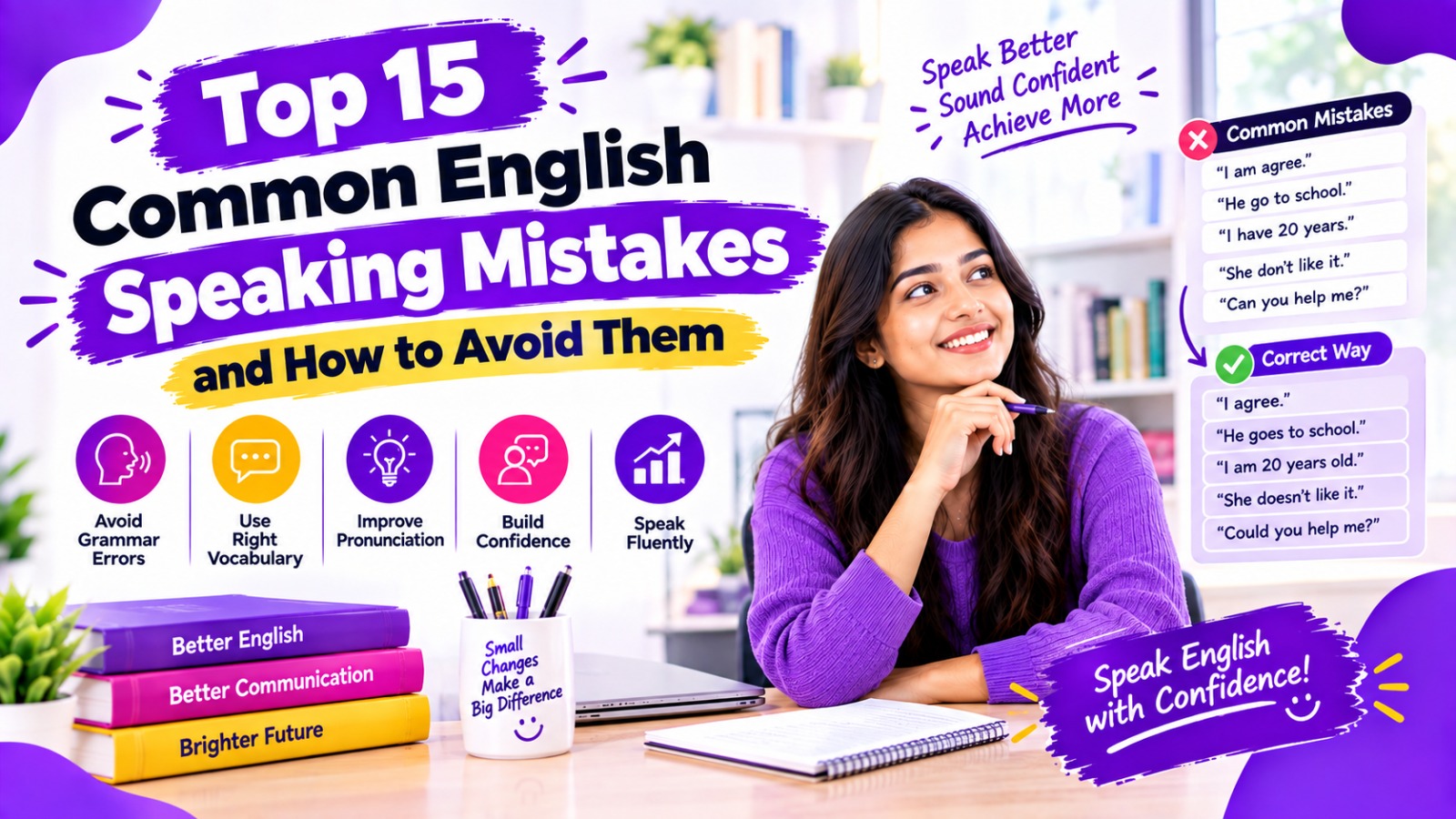
Speaking English confidently can be challenging, especially when you are learning English as a second language. Many learners understand English when reading or listening but hesitate when they have to speak.
The problem is often not a lack of knowledge. It can be caused by grammar mistakes, incorrect pronunciation, limited vocabulary, direct translation from another language, fear of making mistakes, or insufficient speaking practice.
The good news is that most common English speaking mistakes can be improved with regular practice and awareness.
Whether you are a student, job seeker, fresher, working professional, or someone preparing for interviews, improving spoken English can help you communicate more clearly in everyday and professional situations.
Here are 15 common English speaking mistakes and practical ways to avoid them.
1. Using the Wrong Verb Form
One of the most common English mistakes is using an incorrect verb form.
Incorrect:
“She go to college every day.”
Correct:
“She goes to college every day.”
Another example:
Incorrect:
“I am work in Ahmedabad.”
Correct:
“I work in Ahmedabad.”
The verb must match the tense and sentence structure.
How to avoid it
Practice common sentence patterns:
- I work.
- I am working.
- I worked.
- I have worked.
- I will work.
Understanding basic tenses can significantly improve sentence accuracy.
2. Confusing “Is,” “Am,” and “Are”
Learners sometimes use the wrong form of the verb “to be.”
Incorrect:
“I is a student.”
Correct:
“I am a student.”
Incorrect:
“They is ready.”
Correct:
“They are ready.”
A simple rule is:
- I → am
- He/She/It → is
- You/We/They → are
Practice
Create short sentences:
I am ready.
She is busy.
They are students.
We are learning English.
3. Incorrect Use of “Do” and “Does”
“Do” and “does” are frequently confused when asking questions or forming negative sentences.
Incorrect:
“Does you work here?”
Correct:
“Do you work here?”
Incorrect:
“Do she speak English?”
Correct:
“Does she speak English?”
Remember:
- I/You/We/They → do
- He/She/It → does
Examples
Do you understand?
Does he work here?
Do they live in Ahmedabad?
Does she speak English?
4. Confusing “Have” and “Has”
Another common mistake is using “have” and “has” incorrectly.
Incorrect:
“She have a car.”
Correct:
“She has a car.”
Incorrect:
“They has a meeting.”
Correct:
“They have a meeting.”
Use:
- I/You/We/They → have
- He/She/It → has
Examples
I have a laptop.
She has a new job.
They have a meeting.
He has experience.
5. Incorrect Use of Articles: “A,” “An,” and “The”
Articles can be confusing for English learners.
Incorrect:
“I bought a umbrella.”
Correct:
“I bought an umbrella.”
Use “an” before a vowel sound.
Examples:
- an apple
- an umbrella
- an hour
- an engineer
Use “a” before a consonant sound.
Examples:
- a book
- a student
- a university
- a car
“The” is generally used when referring to something specific.
“I bought a book.”
“The book is interesting.”
6. Incorrect Use of Prepositions
Prepositions such as in, on, at, to, for, and from can be difficult.
For example:
Incorrect:
“I am good in English.”
Correct:
“I am good at English.”
Another example:
Incorrect:
“I will meet you on Monday at 5 PM.”
This sentence is correct.
A useful basic pattern is:
- at → specific time or location
- on → days and dates
- in → months, years, larger periods, and many enclosed locations
Examples:
at 5 PM
on Monday
in January
in 2026
Learning common phrases is often more effective than memorizing isolated preposition rules.
7. Translating Directly From Your Native Language
Many English learners first create a sentence in their native language and then translate it word by word into English.
This can create unnatural or incorrect sentences.
For example, a learner may construct a sentence according to their native-language structure rather than natural English sentence order.
How to avoid it
Try to think in simple English sentences.
Instead of translating a complicated thought, break it into smaller sentences.
For example:
“I was tired, so I went home early.”
This is easier and more natural than trying to translate a long sentence word by word.
Start thinking in English for simple activities:
“I am getting ready.”
“I am going to work.”
“I need to buy groceries.”
“I have a meeting today.”
8. Using Incorrect Pronunciation
Good English communication is not only about grammar.
Pronunciation also matters because incorrect pronunciation can make a word difficult for another person to understand.
Commonly confused words include:
- live / leave
- ship / sheep
- full / fool
- advice / advise
- desert / dessert
How to improve pronunciation
Listen carefully to native and fluent English speakers.
You can:
- Listen to English podcasts
- Watch English interviews
- Use pronunciation dictionaries
- Repeat sentences aloud
- Record your own voice
- Practice difficult words repeatedly
Focus on clear pronunciation, not on copying a particular accent.
9. Speaking Too Fast
Some learners believe that speaking quickly means speaking fluently.
It does not.
Speaking too fast can make your pronunciation unclear and can cause more grammar mistakes.
Instead of rushing, speak at a comfortable pace.
For example:
“I would like to explain the project.”
Pause naturally between ideas.
A short pause is better than filling every gap with unnecessary words.
Practice technique
Read a paragraph aloud slowly.
Then repeat it at a natural conversational speed.
Focus on:
- Clarity
- Pronunciation
- Pauses
- Sentence structure
10. Overusing Filler Words
Filler words are words or sounds used when someone needs time to think.
Examples include:
- um
- uh
- like
- actually
- basically
- you know
Using a few fillers naturally is normal.
However, excessive use can make your speech less clear and less confident.
Instead of:
“Actually, um, basically, I think, you know, we should…”
Try:
“I think we should…”
How to improve
When you need time to think, take a short pause instead of immediately using a filler word.
Silence for a second is perfectly acceptable during a conversation.
11. Using Difficult Words Unnecessarily
Some learners believe that using complicated vocabulary makes their English sound more professional.
However, communication is usually more effective when the message is clear.
Instead of:
“I would like to elucidate the aforementioned circumstances.”
You can simply say:
“I would like to explain the situation.”
Simple English can be professional English.
Focus on:
- Clarity
- Accuracy
- Context
- Appropriate vocabulary
rather than trying to use difficult words in every sentence.
12. Confusing Similar Words
English contains many words that look or sound similar but have different meanings.
Examples include:
Affect vs Effect
Affect is commonly used as a verb.
“The delay affected the project.”
Effect is commonly used as a noun.
“The delay had an effect on the project.”
Advice vs Advise
Advice is a noun.
“She gave me useful advice.”
Advise is a verb.
“I advise you to practice regularly.”
Their vs There vs They’re
Their = belonging to them
“Their office is nearby.”
There = a place
“The office is over there.”
They’re = they are
“They’re working today.”
Learning these differences can improve both spoken and written English.
13. Using Incorrect Sentence Structure
English generally follows a basic sentence structure:
Subject + Verb + Object
For example:
“I read books.”
“She studies English.”
“They completed the project.”
Learners may sometimes rearrange words according to the structure of their first language.
How to improve
Start with short sentences.
Instead of trying to speak a very long sentence, divide your thoughts.
For example:
“I joined a course last month. I am learning digital marketing. I am also improving my English.”
Short, correct sentences can be much easier to understand than one long sentence with multiple errors.
14. Being Afraid of Making Mistakes
This is one of the biggest barriers to improving spoken English.
Some learners understand English but avoid speaking because they are afraid that other people will notice their mistakes.
As a result, they get less practice.
Remember that mistakes are part of language learning.
If you never speak because you are afraid of making mistakes, you reduce the opportunities to improve.
Better approach
Treat mistakes as feedback.
Instead of thinking:
“My English is bad.”
Think:
“I made a mistake, so now I know what I need to practice.”
Confidence usually develops through practice and repeated exposure, not by waiting until your English becomes perfect.
15. Not Practicing English Regularly
One of the most common problems is inconsistent practice.
Studying English for several hours once a month is usually less useful than practicing for a short period every day.
You can create a simple daily routine.
15-Minute English Speaking Routine
5 minutes: Read something aloud.
5 minutes: Speak about your day or a professional topic.
5 minutes: Listen to your recording and identify mistakes.
As your confidence improves, increase the practice time.
Common English Mistakes: Quick Reference
| Mistake | Incorrect | Correct |
|---|---|---|
| Verb agreement | She go to work. | She goes to work. |
| Be verb | I is ready. | I am ready. |
| Do/Does | Does you work here? | Do you work here? |
| Have/Has | She have a car. | She has a car. |
| Article | A umbrella | An umbrella |
| Preposition | Good in English | Good at English |
| Pronunciation | Mispronouncing words | Practice correct pronunciation |
| Sentence structure | Word order from native language | Use natural English structure |
| Fillers | Um… actually… basically… | Use short pauses |
| Vocabulary | Unnecessarily complex words | Clear and simple words |
How to Improve English Speaking Step by Step
Improving spoken English is a gradual process. You do not need to master everything immediately.
Build Basic Grammar
Start with:
- Present tense
- Past tense
- Future tense
- Helping verbs
- Articles
- Prepositions
- Pronouns
- Subject-verb agreement
Improve Your Vocabulary
Learn useful words related to:
- Work
- Education
- Travel
- Shopping
- Technology
- Business
- Daily activities
Try to learn words in sentences instead of memorizing isolated words.
Improve Listening
Listen to English every day through:
- Podcasts
- Interviews
- Educational videos
- News
- Movies and series
Focus on how words are pronounced and how sentences are constructed.
Speak Every Day
Talk about:
- Your daily routine
- Your education
- Your job
- Your hobbies
- Your goals
- Current projects
You can even speak to yourself while doing everyday activities.
Record Yourself
Recording your voice can help you identify:
- Pronunciation problems
- Repeated filler words
- Grammar mistakes
- Speaking speed
- Unclear sentences
Get Feedback
A teacher, trainer, mentor, or communication partner can help identify mistakes that you may not notice yourself.
English Speaking Practice for Students and Job Seekers
Students and job seekers can focus on professional situations such as:
Self-Introduction
Practice answering:
“Tell me about yourself.”
Education
Explain:
“What did you study?”
Career Goals
Practice:
“What are your career goals?”
Skills
Explain:
“What skills do you have?”
Experience
Practice:
“Tell me about your previous experience.”
Strengths and Weaknesses
Learn how to explain these naturally and professionally.
Regular practice can make interviews less stressful because you become familiar with common professional conversations.
English Speaking for Working Professionals
Working professionals may need English for:
- Team meetings
- Client calls
- Presentations
- Emails
- Interviews
- Networking
- Business discussions
- Reports
- Workplace conversations
Professional English does not mean using complicated vocabulary.
It means communicating information clearly, politely, and appropriately for the situation.
How a Spoken English Course Can Help
A structured Spoken English course can be useful for learners who need regular guidance and practice.
A practical course may cover:
- Grammar fundamentals
- Vocabulary
- Pronunciation
- Conversation practice
- Listening skills
- Public speaking
- Interview preparation
- Presentation skills
- Business English
- Professional communication
For learners looking for Spoken English courses in Ahmedabad, it is useful to choose training that includes practical speaking exercises rather than only theoretical grammar lessons.
Look for opportunities to practice:
- One-to-one conversations
- Group discussions
- Presentations
- Role plays
- Interviews
- Business conversations
Frequently Asked Questions
What are the most common English speaking mistakes?
Common mistakes include incorrect verb forms, subject-verb agreement errors, incorrect articles and prepositions, poor pronunciation, direct translation from another language, excessive filler words, incorrect sentence structure, and lack of regular speaking practice.
How can I avoid English speaking mistakes?
Practice English regularly, learn basic grammar, listen to fluent speakers, speak aloud, record yourself, learn vocabulary in context, and get feedback from a teacher or communication partner.
How can I improve my English speaking skills at home?
You can read aloud, practice speaking to yourself, record your voice, watch English videos, repeat sentences, learn useful phrases, and have conversations with English-speaking friends or language partners.
How long does it take to improve spoken English?
The time varies from person to person. Improvement depends on your starting level, practice frequency, exposure to English, and the type of practice you do. Consistent daily practice can help you make gradual progress.
Why do I understand English but struggle to speak it?
This often happens because listening and reading skills develop differently from speaking skills. You may understand English but lack enough active speaking practice. Regular conversation and speaking exercises can help bridge this gap.
Is grammar necessary for speaking English?
Basic grammar is useful because it helps you form clear and accurate sentences. However, you do not need perfect grammar before you start speaking. Practice speaking while gradually improving your grammar.
How can I improve English pronunciation?
Listen carefully to correct pronunciation, use reliable pronunciation resources, repeat words and sentences aloud, and record yourself to compare your pronunciation.
How can I stop being afraid of speaking English?
Start with simple conversations and practice in comfortable situations. Accept that mistakes are a normal part of learning. Focus on communicating your message rather than trying to speak perfectly.
What is the best way to learn English vocabulary?
Learn useful words in context. Instead of memorizing a word alone, learn it as part of a sentence and use it in your own conversation.
Is spoken English important for getting a job?
Spoken English can be useful for interviews, workplace conversations, presentations, client communication, and professional networking, particularly in roles where regular communication is required.
Conclusion
Improving English speaking skills is not about speaking perfect English from the beginning. It is about understanding common mistakes, practicing regularly, and gradually becoming more accurate and confident.
The 15 mistakes discussed in this article include incorrect verb forms, confusion between helping verbs, article and preposition errors, pronunciation problems, direct translation, excessive filler words, incorrect sentence structure, and fear of making mistakes.
A simple combination of grammar practice, listening, reading aloud, daily speaking, recording, and feedback can help you improve over time.
For students, freshers, job seekers, and working professionals, stronger English communication can also make everyday academic and workplace interactions easier.
If you are looking for structured learning, a practical Spoken English or Business English course in Ahmedabad can provide guided practice, conversation activities, presentations, interview preparation, and professional communication training.
The most important step is simple: start speaking, keep practicing, learn from your mistakes, and improve one step at a time.