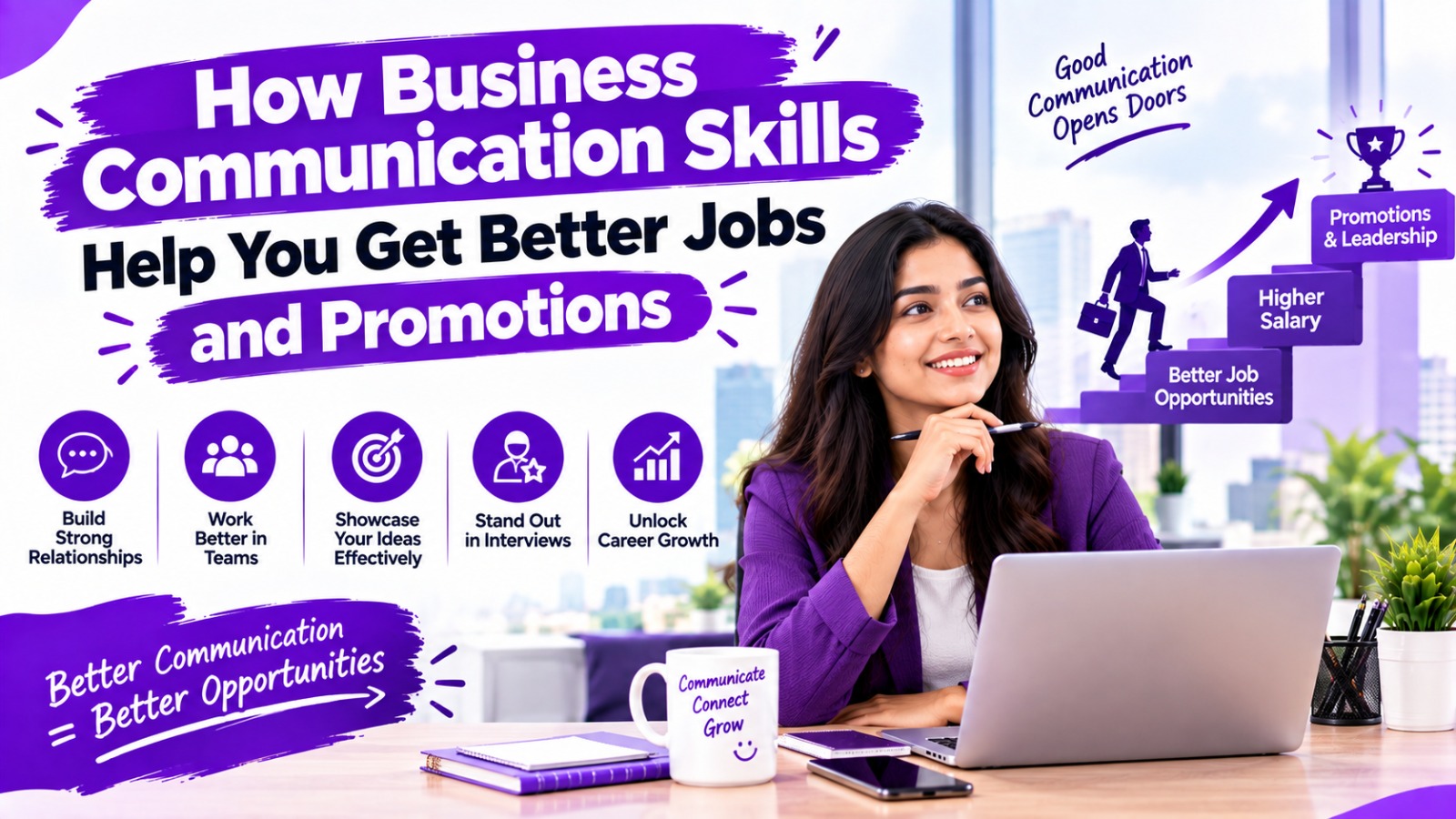
In today’s competitive job market, technical qualifications alone may not always be enough to build a successful career. Employers also look for professionals who can communicate clearly, confidently, and professionally.
Whether you are a student looking for your first job, a working professional trying to change careers, or an employee preparing for a promotion, strong business communication skills can make a significant difference.
Business communication includes much more than speaking English fluently. It involves the ability to communicate ideas, write professional emails, participate in meetings, present information, listen actively, communicate with clients, work with colleagues, and handle workplace situations professionally.
For students and professionals in Ahmedabad and other growing business markets, improving communication skills can be a practical part of career development.
What Are Business Communication Skills?
Business communication skills are the abilities required to exchange information effectively in a professional environment.
They include:
- Speaking clearly and confidently
- Professional English communication
- Business writing
- Email communication
- Active listening
- Presentation skills
- Meeting communication
- Negotiation skills
- Client communication
- Team communication
- Telephone and video-call etiquette
- Non-verbal communication
- Asking appropriate questions
- Giving and receiving feedback
- Explaining ideas clearly
- Handling professional conversations
Good business communication is not about using complicated English or difficult vocabulary. It is about making your message clear, professional, relevant, and easy to understand.
Why Business Communication Skills Matter in the Job Market
Employers frequently expect employees to communicate with different people, including managers, colleagues, customers, vendors, and business partners.
Even a technically skilled employee may struggle if they cannot explain their work or communicate effectively with others.
For example, imagine two candidates have similar technical qualifications.
One candidate gives short, unclear answers during an interview and struggles to explain their previous work.
The other candidate explains their experience clearly, listens carefully, answers questions confidently, and communicates professionally.
Communication can influence how employers understand a candidate’s skills, experience, and professional approach.
This is why communication skills are an important part of overall employability.
How Business Communication Skills Help You Get Better Jobs
Better Performance in Job Interviews
An interview is one of the first situations where an employer evaluates your communication ability.
During an interview, you may need to:
- Introduce yourself
- Explain your education
- Describe your experience
- Discuss your strengths
- Explain your career goals
- Answer technical or situational questions
- Ask questions about the role
Strong communication helps you present your qualifications in a structured and understandable way.
Instead of simply saying:
“I worked in digital marketing.”
You can explain:
“During my previous experience, I worked on website content, basic SEO activities, and social media tasks. This helped me understand how digital marketing activities contribute to online visibility.”
The second answer gives the interviewer more useful information.
Helps You Explain Your Skills Clearly
Many candidates have useful skills but struggle to explain them.
For example, someone may know:
- Excel
- Power BI
- SEO
- Social media marketing
- Graphic design
- Accounting
- Customer service
- Data analysis
But during an interview, they may not be able to explain what they actually did with those skills.
Business communication helps you connect your skills with real examples.
A useful structure is:
Skill → Task → Action → Result
For example:
Skill: Excel
Task: Data management
Action: Created reports and organized business data
Result: Made information easier to review and understand
This type of communication makes your professional experience easier for recruiters to understand.
Helps You Make a Strong Professional Introduction
Your introduction is often one of the first opportunities to communicate professionally.
A good professional introduction should generally explain:
- Who you are
- Your educational or professional background
- Your relevant skills
- Your current career direction
- What type of opportunity you are looking for
For example:
“I am a graduate with an interest in digital marketing and business communication. I have been developing my skills in SEO, content marketing, social media, and basic analytics. I am looking for an opportunity where I can apply these skills while continuing to learn and grow professionally.”
The goal is not to memorize a complicated speech. The goal is to communicate naturally and confidently.
Helps You Perform Better in Group Discussions
Many companies use group discussions or collaborative activities during recruitment.
In these situations, employers may observe how candidates:
- Express their opinions
- Listen to others
- Respond to different viewpoints
- Explain ideas
- Stay professional
- Work with a group
- Handle disagreements
Effective communication does not mean talking continuously.
A good communicator also knows when to listen.
For example, instead of interrupting another person, you can say:
“I understand your point. I would like to add another perspective.”
This communicates disagreement or an additional idea without creating unnecessary conflict.
Helps You Communicate During Meetings
Meetings are common in professional environments.
Employees may need to:
- Give updates
- Discuss projects
- Ask questions
- Present ideas
- Explain problems
- Suggest solutions
- Take decisions
- Report progress
Poor communication can create confusion.
For example:
“There is some problem with the project.”
This is vague.
A clearer professional explanation would be:
“The project is currently delayed because we are waiting for the required data. We expect to receive it by Friday and can continue the next stage after that.”
The second statement provides a problem, reason, and expected next step.
Helps You Write Better Professional Emails
Email communication is an essential workplace skill.
Employees may write emails to:
- Managers
- HR departments
- Clients
- Customers
- Vendors
- Colleagues
- Business partners
A professional email should generally be:
- Clear
- Concise
- Polite
- Relevant
- Properly structured
Instead of writing:
“Send me the file.”
A professional workplace version could be:
“Could you please share the updated file when convenient? We need it to proceed with the next stage of the project.”
The message remains simple while sounding more professional.
Helps You Communicate With Clients
Client communication is particularly important in roles involving:
- Sales
- Marketing
- Customer support
- Consulting
- Account management
- Business development
- IT services
- Digital marketing
- Finance
- Hospitality
Clients may not always understand technical terminology.
A strong communicator can explain complex information in simple language.
For example, instead of explaining SEO using technical terms only, a digital marketing professional may tell a client:
“SEO helps improve the visibility of your website in search engines so that potential customers can discover your business when they search for relevant products or services.”
This makes the concept easier for a non-technical client to understand.
How Communication Skills Help You Get Promotions
Getting hired is only one part of career growth.
Once you are employed, communication skills can also become important for taking on greater responsibilities.
As employees progress in their careers, they often need to communicate with more people and handle more complex situations.
Strong communication can support your ability to:
- Explain work to management
- Lead discussions
- Coordinate teams
- Present reports
- Communicate with clients
- Handle workplace problems
- Give instructions
- Train new employees
- Represent your department
- Present ideas to decision-makers
These responsibilities can become increasingly important as your role develops.
Communication Helps You Demonstrate Leadership
Leadership is not only about managing people.
It also involves communicating direction, expectations, feedback, and decisions.
A professional who can clearly explain:
What needs to be done → Why it matters → How it should be done → When it should be completed
can help a team work more effectively.
For example:
“Let’s complete the first stage by Wednesday. After reviewing the results, we can make the necessary changes before moving to the next stage.”
This is clearer than simply saying:
“Complete this quickly.”
Professional communication helps reduce confusion and establish expectations.
Helps You Build Better Workplace Relationships
Career growth is not only about technical performance.
Employees interact with many people throughout their careers.
Good communication can help you build professional relationships based on:
- Respect
- Trust
- Clarity
- Cooperation
- Active listening
- Professional behaviour
Simple habits can make a difference, such as:
- Listening without interrupting
- Responding politely
- Giving credit to others
- Asking for clarification
- Keeping people updated
- Communicating problems early
- Accepting constructive feedback
These behaviours can contribute to a healthier professional working environment.
Helps You Handle Workplace Conflicts
Disagreements can happen in almost every workplace.
Communication skills can help you address disagreements without unnecessarily escalating them.
Instead of saying:
“You are wrong.”
You could say:
“I understand your perspective. I have a slightly different view based on the information we currently have.”
This keeps the conversation focused on the issue rather than the person.
Effective conflict communication includes:
- Listening to the other person’s perspective
- Avoiding personal attacks
- Focusing on facts
- Asking questions
- Explaining your viewpoint calmly
- Looking for practical solutions
Helps You Give and Receive Feedback
Feedback is an important part of professional development.
Employees may receive feedback about:
- Work quality
- Communication
- Productivity
- Deadlines
- Teamwork
- Customer interactions
- Professional behaviour
Instead of becoming defensive, effective communicators try to understand the feedback and identify what can be improved.
You can respond with:
“Thank you for the feedback. Could you please give me an example so I can understand where I need to improve?”
This demonstrates a willingness to learn.
Business Communication Skills for Different Career Stages
Students
Students can use communication skills for:
- College presentations
- Group projects
- Internships
- Interviews
- Networking
- Resume discussions
- Placement interviews
Developing these skills before entering the workforce can help students become more comfortable in professional situations.
Freshers
Freshers may need communication skills for:
- Job interviews
- Self-introductions
- Team meetings
- Emails
- Customer interaction
- Workplace conversations
Working Professionals
Working professionals can use communication skills to:
- Present projects
- Communicate with managers
- Handle clients
- Lead meetings
- Negotiate
- Give presentations
- Take additional responsibilities
Managers and Team Leaders
Managers may need advanced communication skills for:
- Delegation
- Leadership
- Team meetings
- Conflict resolution
- Performance discussions
- Client relationships
- Strategic presentations
Important Business Communication Skills to Develop
Spoken English
Professional English can be useful when communicating with colleagues, customers, and international teams.
Focus on:
- Clear pronunciation
- Useful vocabulary
- Sentence formation
- Professional phrases
- Confidence
- Fluency
The goal should be effective communication rather than trying to imitate a particular accent.
Active Listening
Communication is a two-way process.
Active listening means paying attention to what the other person is saying instead of preparing your response while they are speaking.
You can improve listening by:
- Avoiding interruptions
- Asking clarifying questions
- Summarizing important points
- Paying attention to tone and context
Business Writing
Learn how to write:
- Professional emails
- Reports
- Proposals
- Meeting notes
- Business messages
- Follow-up emails
Presentation Skills
Learn how to:
- Structure information
- Create simple presentations
- Explain data
- Speak clearly
- Maintain professional body language
- Answer questions
Non-Verbal Communication
Communication also includes:
- Facial expressions
- Eye contact
- Posture
- Gestures
- Tone of voice
- Professional appearance
Your body language can influence how your spoken message is received.
Negotiation Skills
Negotiation can be useful when dealing with:
- Clients
- Vendors
- Salary discussions
- Deadlines
- Project requirements
- Business agreements
Good negotiation involves understanding the other person’s needs while clearly communicating your own position.
How to Improve Business Communication Skills
Improving communication does not require learning everything at once.
Start with simple daily activities.
Read for 15–20 Minutes
Read:
- Business articles
- News
- Professional blogs
- Industry reports
- Company websites
Pay attention to how professional information is written.
Learn Useful Professional Phrases
Instead of memorizing hundreds of difficult words, learn practical expressions such as:
- “Could you please clarify?”
- “I would like to discuss…”
- “Based on the available information…”
- “I would recommend…”
- “Let me explain…”
- “I understand your concern.”
- “Could we schedule a meeting?”
- “Please let me know if you need any additional information.”
Practice Speaking
Choose a professional topic and speak about it for two to five minutes.
For example:
- Explain your job
- Explain your course
- Describe a project
- Explain a product
- Discuss a business problem
Record yourself and listen to the recording.
Practice Writing Emails
Write sample emails for situations such as:
- Asking for information
- Requesting leave
- Following up
- Sending a report
- Scheduling a meeting
- Responding to a customer
Practice Presentations
Choose a simple topic and create a short presentation.
Try to explain the topic without reading every word from the screen.
Join Communication or Business English Training
A structured business communication or spoken English course can provide regular practice, feedback, and professional communication exercises.
For learners in Ahmedabad, communication training can be particularly useful for students, freshers, working professionals, and people preparing for interviews or career changes.
Business Communication Skills and Career Growth
Communication skills should not be considered separately from technical skills.
A strong career profile can combine:
Technical Skills + Communication Skills + Problem-Solving + Professional Behaviour
For example:
A digital marketer may know SEO, Google Analytics, content marketing, and social media.
But they may also need to:
- Explain campaign performance
- Present reports
- Communicate with clients
- Write emails
- Discuss strategies
- Coordinate with designers and developers
Similarly, a data analyst may know Excel, Power BI, SQL, or Python but may need to explain analytical findings to people who do not have a technical background.
This is where communication becomes an important supporting skill.
Business Communication Skills for Job Seekers in Ahmedabad
Ahmedabad has opportunities across sectors such as:
- IT and technology
- Digital marketing
- Finance
- Accounting
- Manufacturing
- Healthcare
- Education
- Retail
- E-commerce
- Customer service
- Business services
Job seekers may therefore benefit from developing both industry-specific knowledge and professional communication abilities.
For students and professionals searching for business communication courses in Ahmedabad, it is useful to look for programs that include practical activities such as presentations, interviews, business writing, group discussions, workplace conversations, and role-playing exercises.
A Simple Business Communication Career Roadmap
Start With Basic English
Work on:
- Vocabulary
- Grammar
- Sentence formation
- Pronunciation
Build Speaking Confidence
Practice:
- Self-introduction
- Everyday professional conversations
- Interview questions
- Short presentations
Learn Workplace Communication
Focus on:
- Emails
- Meetings
- Telephone conversations
- Client communication
- Team discussions
Develop Advanced Skills
Learn:
- Presentations
- Negotiation
- Conflict management
- Business writing
- Leadership communication
Apply the Skills at Work
Use your communication skills in:
- Meetings
- Projects
- Client discussions
- Reports
- Presentations
- Team coordination
Continue Improving
Ask for feedback from:
- Managers
- Mentors
- Trainers
- Colleagues
Then work on specific areas that need improvement.
Common Mistakes to Avoid in Professional Communication
Even people with good English can make communication mistakes.
Avoid:
- Speaking too quickly
- Using unnecessary complicated words
- Interrupting others
- Sending unclear emails
- Using overly casual language in formal situations
- Avoiding questions when something is unclear
- Giving incomplete information
- Using an aggressive tone
- Ignoring feedback
- Speaking without understanding the audience
Good communication is about clarity and purpose, not simply speaking more.
Frequently Asked Questions
How do business communication skills help in getting a job?
Business communication skills can help you perform better in interviews, explain your qualifications, communicate professionally, participate in discussions, and demonstrate that you can interact effectively in a workplace.
Are communication skills important for freshers?
Yes. Freshers often use communication skills during interviews, presentations, group discussions, internships, and their first workplace interactions.
Can communication skills help with promotions?
Communication skills can support career growth by helping employees present ideas, communicate with managers and clients, lead discussions, handle responsibilities, and work effectively with teams.
Is English fluency the same as business communication?
No. English fluency is only one part of business communication. Professional communication also includes listening, writing, presentations, body language, workplace etiquette, negotiation, and the ability to communicate information clearly.
Which communication skills are important for a job interview?
Important skills include self-introduction, clear speaking, active listening, answering questions logically, explaining experience, maintaining professional body language, and asking relevant questions.
How can I improve my business communication skills?
You can improve by reading regularly, practicing speaking, writing professional emails, recording yourself, giving presentations, participating in discussions, and receiving feedback from trainers or experienced professionals.
Are business communication skills useful for non-technical jobs?
Yes. Communication is useful across many roles, including sales, customer service, marketing, HR, finance, administration, education, healthcare, management, and business development.
Can business communication skills help with client handling?
Yes. Client communication requires professionals to understand requirements, explain information clearly, respond to questions, manage expectations, and maintain professional relationships.
What should I learn first: technical skills or communication skills?
Both are important. A practical approach is to develop your technical or industry-specific skills alongside communication skills. Technical knowledge helps you perform the work, while communication helps you explain, coordinate, and apply that knowledge professionally.
Is a business communication course useful for working professionals?
It can be useful when the course includes practical training such as professional email writing, presentations, meetings, client communication, interviews, workplace conversations, and feedback-based practice.
Conclusion
Business communication skills are an important part of modern career development.
They can help you communicate your qualifications during interviews, work effectively with colleagues, interact with clients, present ideas, handle workplace situations, and take on greater responsibilities.
For students and freshers, communication skills can support the transition from education to employment. For working professionals, they can help improve workplace communication and prepare for roles involving greater responsibility.
The most effective approach is not to focus only on speaking fluent English. Instead, develop a complete communication skill set that includes speaking, listening, writing, presentations, professional etiquette, client communication, negotiation, and workplace confidence.
When combined with strong technical or industry-specific knowledge, effective communication can become a valuable part of your long-term professional development.